
Throughout our lives, there are many tests we take to determine aptitude, intelligence, and skill. There are the SATs and ACTs of high school to college exams and aptitude tests. But of all the ways to measure intelligence, the IQ test is largely seen as one of the best ways to measure cognitive ability.
This does not mean that your IQ score will determine your success and happiness in life, or that your IQ is the only thing that matters when it comes to your intelligence.
There is a lot that goes into human intelligence and our ability to problem solve. This one number cannot encompass everything that our mind can do, but it can still be a useful tool. This blog post covers what IQ scores are, how they are measured on a IQ scale, and what would constitute a high IQ score.
What Does IQ Stand For?
IQ stands for “Intelligence Quotient”. It measures your ability to problem solve using logic, spatial awareness, verbal reasoning, and visual abilities, among others.
Unlike standardized tests like the ACT or SAT, the IQ test does not just measure your ability to memorize facts, although knowing a lot of things can definitely help you on an IQ test. Instead, it focuses on both your fluid and crystallized intelligence.
Fluid intelligence is the ability to reason and think through problems. Crystalized intelligence is your accumulation of knowledge and facts.
An IQ test may ask questions like:
- Verbal reasoning (analogies and vocabulary)
- Numerical reasoning (math and number problems)
- Spatial reasoning (identifying patterns and shapes)
- Inductive and deductive reasoning tests
- General knowledge about facts and information
The type of intelligence that IQ measures is not the only type of intelligence nor is it the most important type. Emotional Intelligence (EQ) is considered by some to be just as, if not more, important than IQ. We’ll talk more about EQ vs IQ below.
A Breakdown of the IQ Number Scale
What is a high IQ score? What is a low IQ score? How common are high IQ scores? Part of this depends on what scale and test you take. The two most common types of IQ tests are the Wechsler Intelligence Scale and the Stanford-Binet Intelligence Scale.
The Stanford-Binet test was originally developed for children. Its goal was to identify possible neurological disorders so that proper treatment could be applied. It provides a single intelligence score.
The Wechsler Intelligence test was developed for adults and provides different types of scores for different areas of intelligence.
Both types of tests are still in use today, with different needs requiring different tests. Here’s a quick breakdown of the IQ scale using the Wechsler Intelligence Scale, and where you might fall in it:
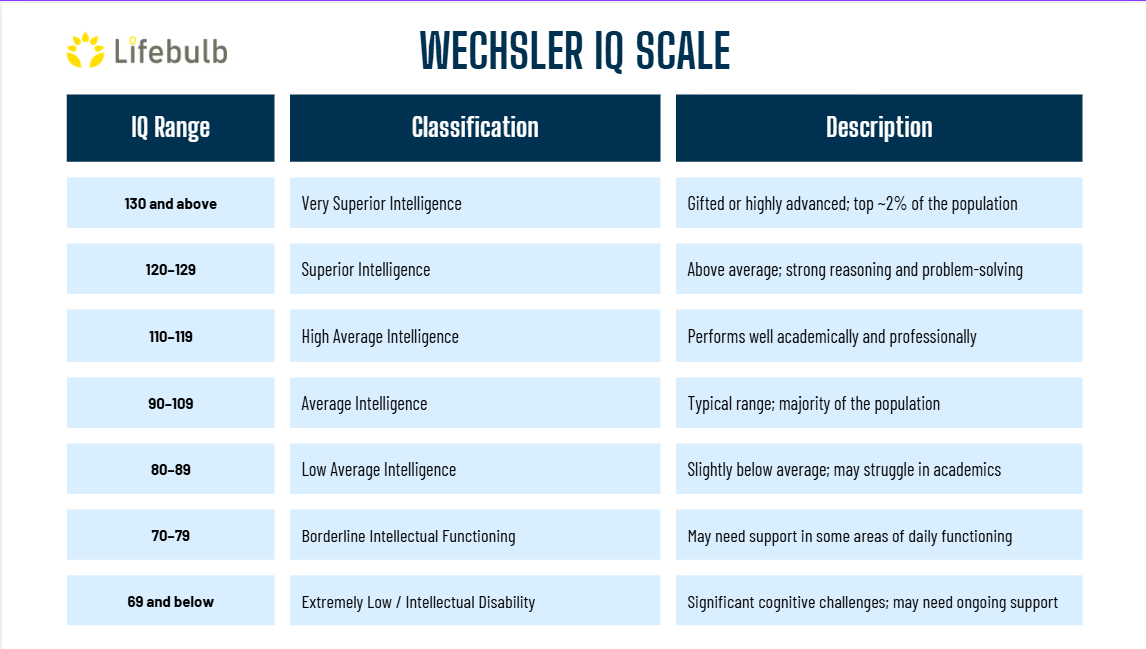
Note: IQ tests measure certain cognitive skills (like logic, reasoning, and problem-solving), but they don’t capture creativity, emotional intelligence, motivation, or social skills — all of which are also important forms of intelligence.
If you are wondering what a.good IQ score is? The average IQ score is between 85 and 115, 68% of people will have an IQ score within this range. A high IQ score is considered to be any score above a 119. That place individuals on the superior or very superior intelligence categories on the IQ scale. When an IQ score falls into the 130 and above portion of the IQ scale, that is when it may be considered “genius level”.
What does a high IQ score actually mean?
So you scored high on an IQ test…now what? Having a high IQ does not mean you will automatically be more successful in life. All it means is that you have greater cognitive abilities than most other people.
You might be a better problem solver, able to identify patterns quickly, and have better memorization skills. You also likely have an easier time with abstract thinking, reasoning, and comprehension.
However, IQ does not measure motivation, creativity, or social skills, all of which are important skills for success. A high IQ with no motivation will get you just as far as a low IQ, and a low IQ with high motivation will get you further than someone with a high IQ.
This is where emotional intelligence (EQ) comes in. Emotional intelligence is the ability to recognize, understand, and manage your emotions and recognize and understand the emotions of others. It's charisma, empathy, and social skills all rolled into one number. Some people believe that EQ is more important than IQ, and they might be right. Certain professions certainly require higher EQ than IQ, and different challenges will require a different skill set.
In the end, whether you have a high IQ or a low IQ, a high EQ or a low EQ, you have with you a set of tools. How you use those tools, and how you rely on others for help, is up to you.
Is IQ genetic or learned?
It’s been proven that IQ has a strong genetic component, but we aren’t quite sure what that gene is or how much our environment influences it.
Studies have shown that IQ has up to an 80% genetic heritability. The rest of it is determined by gene-environment interactions. For example:
- Poverty and trauma at a young age are limiting factors when it comes to IQ.
- A nurturing, safe environment may allow for higher IQs.
Is it possible to grow your IQ score?
Yes and no. IQ does have a high genetic component, so it tends to be stable relative to your age. But it also has that environmental component. Feeding your intelligence, trying to get smarter, and challenging yourself will result in being more intelligent.
Removing barriers like trauma or chronic stress from your life can also help you become more intelligent. (A body in fight or flight mode is not one that is able to focus on problem-solving.) Therapy can help with this. A licensed professional therapist can give you the tools you need to clear out the weeds from your life, so you can let your true intelligence and potential grow.
If you want to talk to a therapist about taking an IQ test or about your IQ, contact Lifebulb therapy. We have therapists who are available to help you today.