
Somatic Therapy draws from techniques used by Thomas Hanna, who coined the term in 1970, but many of the techniques have been used in health and wellness for hundreds, if not thousands, of years.
What is somatic therapy? And is it the same as somatic exercise?
Somatic therapy aims to address the physical effects of trauma, anxiety, depression, and other mental health disorders. The idea is to heal the mind through healing the body, commonly called a “bottom-up” approach. This is the opposite approach to many cognitive-based therapies like Cognitive Behavioral Therapy (CBT), which prioritizes healing “top-down”, or from the mind, down into the body.
It’s a helpful therapy for those who find themselves stuck with CBT, DBT, and other cognitive-based therapies. Somatic therapy prioritizes movement to release pent-up tension, emotion, and trauma stored in our bodies.
Those movements are called somatic exercises.
What Is a Somatic Exercise?
Somatic exercises aim to increase bodily awareness. They do this through alternating movement and relaxation.
It’s been widely accepted that trauma is stored in our bodies. “Trauma Keeps the Score”, a book by Bessel van der Kolk, is a novel that popularized the belief, and many studies have backed it up. It’s not just our minds that remember trauma and fear that what happened to us will happen again, our nervous system and muscles know it too.
For example, have you ever had a strong physical reaction to something without knowing why? Maybe you drove past a stoplight, and your heart rate picks up, and you start to sweat. It’s not until later that you remember that was the intersection where you were mugged years ago. Your mind had started to forget, but your body didn’t.
Somatic therapy aims at healing these reactions held within our body by releasing them through movement.
Do Somatic Exercises Really Work?
Somatic therapy has just recently garnered enough attention that larger research studies are being done to test its effectiveness. Many studies have pointed to yes, somatic exercises and somatic therapy work. But the general consensus is that more research needs to be done to conclusively say.
Most of the research done has focused on healing from PTSD and anxiety, both of which show improvements when somatic therapy is used.
Additionally, somatic therapy is backed by a host of anecdotal evidence suggesting it is useful for far more than PTSD and anxiety.
How Do Somatic Exercises Release Trauma?
Somatic exercises may be the perfect combination of many practices that are known to improve well-being and reduce stress. It utilizes two heavily researched and proven techniques for improving our mental health: mindfulness and exercise.
Somatic exercises work to release stored trauma, stress, and emotion by doing a few things:
- Improving the mind-body connection
- Easing muscle tension
- Reducing stress
- Utilizing mindfulness
Our bodies often respond to our emotions, but our emotions can also respond to our bodies. You can easily stress yourself out by purposefully hyperventilating, and you can make yourself angrier by clenching your fists.
Our bodies and minds are constantly communicating with one another. Somatic exercise seeks to hijack that communication for your benefit: by calming the body to tell the mind that you are safe, calm, and in control.
13 Somatic Exercises Anyone Can Do
You don’t have to go for a long run or hit the gym for hours on end to release this trapped, unhealthy energy. Somatic exercises are often simple, short, and easy to do on your own. Try a few today and notice how you feel.
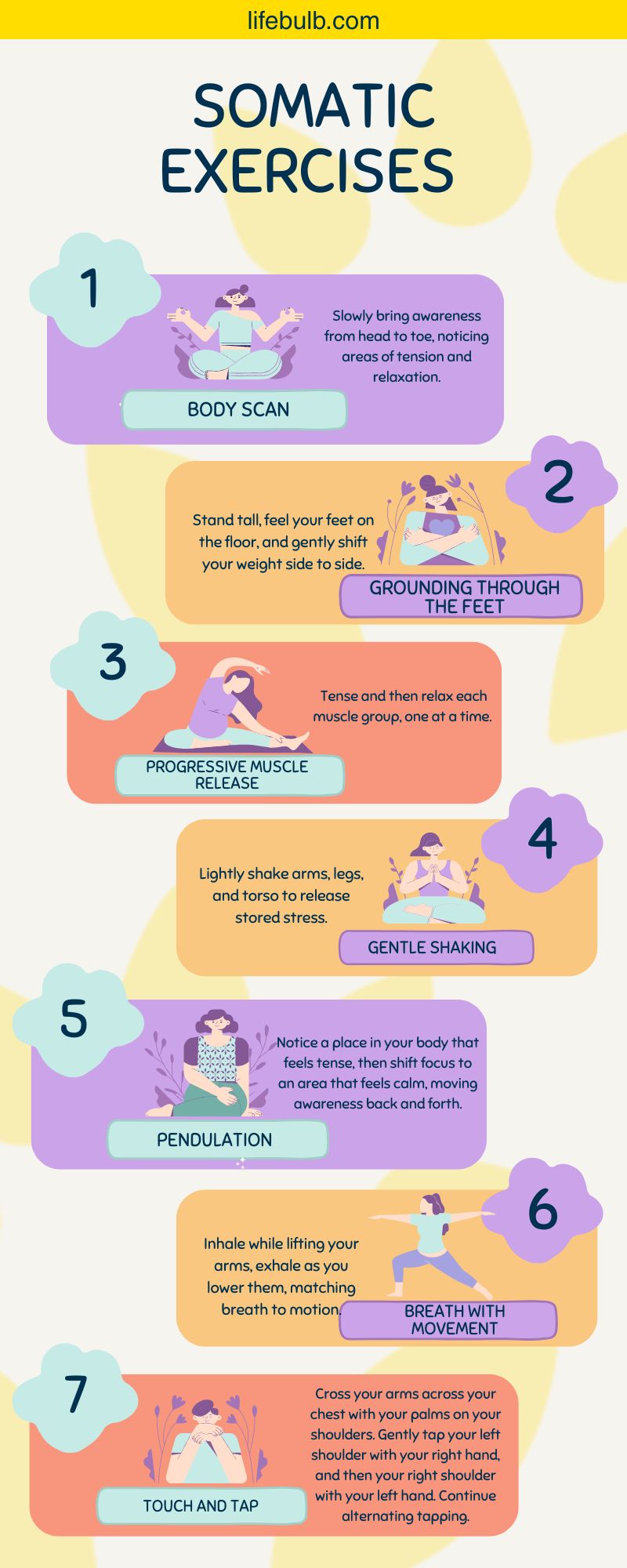
- Body scan – Slowly bring awareness from head to toe, noticing areas of tension and relaxation.
- Grounding through the feet – Stand tall, feel your feet on the floor, and gently shift your weight side to side.
- Progressive muscle release – Tense and then relax each muscle group, one at a time.
- Gentle shaking – Lightly shake arms, legs, and torso to release stored stress.
- Pendulation – Notice a place in your body that feels tense, then shift focus to an area that feels calm, moving awareness back and forth.
- Orienting exercise – Slowly look around your space, noticing colors, textures, and shapes to bring yourself into the present.
- Breath with movement – Inhale while lifting your arms, exhale as you lower them, matching breath to motion.
- Touch and tap – Cross your arms across your chest with your palms on your shoulders. Gently tap your left shoulder with your right hand, and then your right shoulder with your left hand. Continue alternating tapping.
If you have the time to do a longer somatic exercise, try one of these longer somatic exercises:
- Dancing - any type, and you don’t have to be good at it to reap the benefits!
- Yoga - move slowly and focus on how your body feels
- Pilates - instead of going for the burn, slow down to appreciate how your body feels
- Mindful walking - go for a walk and take the time to notice your environment
- Tai Chi - possibly one of the oldest forms of somatic exercise, Tai Chi is proven to have great mental and physical health benefits
These are just a few somatic exercises you can do to promote physical and mental health.
Somatic Therapy
Somatic therapy is a therapy modality that some therapists choose to specialize in. It is a body-centered approach that can be effective at treating PTSD, anxiety, and more.
If you’re interested in talking to a therapist about how somatic therapy can help you, contact our team at Lifebulb. We have somatic therapists near you with little to no wait times and who accept most major insurances.
Contact our team today or browse our list of therapists near you.
.webp)

.webp)