
A personality disorder is a pattern of long-term behaviors that are outside cultural and societal norms. Importantly, a personality disorder must also cause distress or functional impairment to the individual or people around them.
Professional therapists recognize 10 types of personality disorders; the most commonly talked about are the Cluster B personality disorders, which include Borderline Personality Disorder, Narcissistic Personality Disorder, Antisocial Personality Disorder, and Histrionic Personality Disorder.
Less talked about but still highly relevant are the Cluster C Personality disorders. These types deal with fear and anxiety and can be highly disruptive to a person’s health and happiness. Avoidant Personality Disorder is a Cluster C disorder in which a person experiences chronic feelings of inadequacy and acute sensitivity to criticism. As a result, they may avoid social gatherings and relationships altogether, becoming avoidant.
Avoidant personality disorder (AVPD) is often misunderstood and confused for Social Anxiety Disorder or an avoidant attachment style. Although there are some overlaps, these are all unique mental health conditions. Let’s dive into the symptoms, causes, and treatments for avoidant personality disorder.
What is Avoidant Personality Disorder?
A Cluster C personality disorder, Avoidant personality disorder (AVPD) is characterized by fear and anxiety, especially around acceptance and rejection. Unlike anxiety disorders, however, anxiety is not the core cause of distress. People with AVPD have chronically low self-esteem, and avoid social situations because of it. They fear rejection because they believe they deserve to be rejected.
These chronic feelings of inadequacy can cause other mental health issues to evolve, such as Social Anxiety Disorder, Depression, and Agoraphobia, among others.
Avoidant Personality Disorder vs Social Anxiety
Researchers once thought that Avoidant Personality Disorder was a severe form of Social Anxiety Disorder, but this was later proved false. Two-thirds of people with AVPD do not qualify for a Social Anxiety Disorder diagnosis.
The core difference between Social Anxiety Disorder and Avoidant Personality Disorder is the low self-esteem. Whereas people with SAD may have low self-esteem, it will be a result of the anxiety. The same is reversed for those with AVPD: low self-esteem is the root, and the anxiety is secondary. Not everyone with AVPD will experience anxiety in social situations, whereas that is a critical part of the diagnosis criteria for Social Anxiety Disorder.
Still, there is a decent overlap between the two disorders. When someone has both, their symptoms are likely more severe.
Avoidant Personality Disorder Symptoms
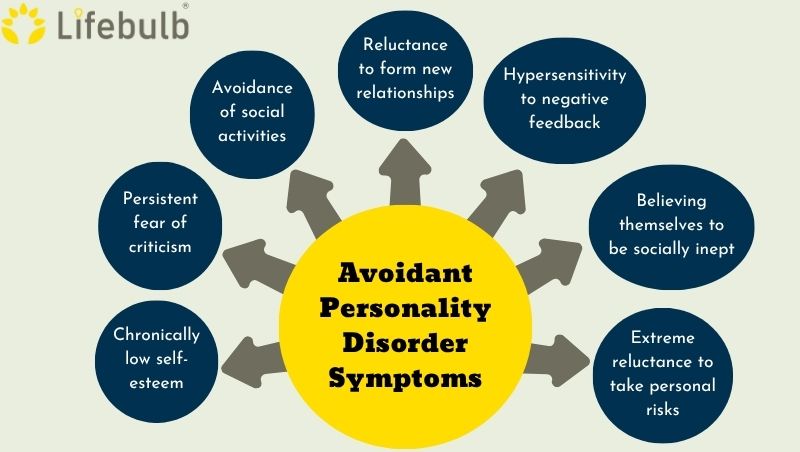
According to the DSM-5, the handbook for diagnosing and treating mental health disorders, symptoms of Avoidant Personality Disorder are:
- Chronically low self-esteem.
- Persistent fear of criticism, disapproval, or rejection in social situations.
- Avoidance of social activities due to fears of being ridiculed or shamed.
- Reluctance to form new relationships due to feelings of inadequacy.
- Hypersensitivity to negative feedback and criticism.
- Believing themselves to be socially inept, unappealing, or inferior to others.
- Extreme reluctance to take personal risks or engage in new activities that may result in embarrassment or criticism.
These symptoms collectively contribute to significant distress and impairment in various areas of an individual's life, impacting their social, occupational, and personal functioning.
What Causes Avoidant Personality Disorder?
Not much is known about the causes of personality disorders. Most researchers agree that there are two main causes of all personality disorders, which are:
- Genetics: One study estimated that genetics accounts for 64% of the likelihood of AVPD developing. This is generally true for all personality disorders. Although exact genetic makeup has not been identified, there seems to be a strong genetic component on the occurrence of personality disorders.
- Environmental Factors: Childhood experiences play a crucial role in how personalities are formed. Negative childhood experiences can put people at risk for developing personality disorders. Those with AVPD may have faced rejection or have been treated differently as a young child. Having an insecure attachment style from a young age may also contribute to the development of AVPD later on in life. An insecure attachment style is formed when a caregiver is cold, withdrawn, or neglectful towards a young child.
More research is needed to say for certain what causes avoidant personality disorder, but these two factors most likely play an important role.
Treatment for Avoidant Personality Disorder
Treating personality disorders can be tricky, as the people who have struggled with them have done so for years and may have deeply rooted beliefs and thinking patterns that can be difficult to untangle. However, the research shows psychotherapy is effective at managing and eventually reducing the severity of personality disorders.
This is especially true for people with Avoidant Personality Disorder, since AVPD likely brings them a significant amount of distress. People with avoidant personality disorder usually want to change, but don’t know how or don’t believe they can. This is what therapy can help with.
Therapy techniques for AVPD include:
- Psychodynamic Therapy: This type of talk therapy can help you identify patterns throughout your life that may have contributed to your current state of thinking, and behaving. Psychodynamic therapy often examines childhood experiences to get to the root of core beliefs. These beliefs, such as “No one will ever love me.” or “I’m too weird for anyone to truly like me.” have massive impacts on our self-esteem, and addressing them is a critical part of treating avoidant personality disorder.
- Cognitive Behavioral Therapy: CBT works on identifying negative, untrue thoughts and replacing them with positive, true thoughts. People with Avoidant Personality Disorder are likely to have a lot of self-deprecating thoughts, such as “I’m so stupid.” These thoughts eventually form into beliefs, which influence how we behave. If you think you’re stupid, you’ll let opportunities pass you by and claim they only did so because you weren’t smart enough. This is a cognitive distortion and something a CBT therapy can help you with.
- Medication: There is no medication that treats personality disorders, but people with Avoidant Personality Disorder may struggle with anxiety and depression which can make their symptoms worse. Taking medication can help alleviate these auxiliary conditions and provide more space to work on the personality disorder within therapy. The best treatment approach involves both medication and therapy.
Therapy for people with a personality disorder is not a quick fix. Some symptoms may always be present, but the goal of therapy is to make it so there is less impairment on the person with a personality disorder. Other goals of therapy for avoidant personality disorder include:
- Rebuild a negative sense of self.
- Unlearn and challenge negative thinking patterns.
- Stop self-destructive behaviors, like self-isolation.
- Explore root causes of fear and anxiety.
- Build healthy coping skills to cope with anxiety and low self-esteem when it rises.
Therapy for avoidant personality disorder can be a powerful way to combat the negative thought and behavioral patterns associated with the disorder. If you are ready to talk to a therapist about a personality disorder, contact Lifebulb’s support staff or browse our list of therapists near you. We have therapists who specialize in personality disorders. We accept most insurances and have no wait times.
.webp)
.webp)
.webp)
.webp)