
It’s that time of year: The wind has an autumnal chill to it, pumpkin spice lattes are back, and stores have a dedicated “back to school” section crowded with over 10 types of notebooks (and yet, somehow, the one notebook your child actually needs is missing).
The transition back to school for a family can be a hectic and stressful time. Even older kids have a hard time adjusting from the free schedule of summer to the regimented routine of school. For younger kids, especially those who are just starting school in preschool or kindergarten, the back-to-school transition can become a minefield of behavioral issues, emotional outbursts, and skewed sleep schedules.
If you’re already wishing you could go back to the golden days of summer, you’re not alone. Many kids struggle with the transition back to school, some to the point of fearing school. The anxiety of leaving their home, their safe space, and the people they’ve relied on all their life can be stressful. To their young brains, it may feel like a life-or-death situation, and they may react with one of the four trauma responses.
Fortunately, thousands of parents have successfully navigated this time period, and with the right tools, you can too. This article will go over why young kids have a fear of school and how to deal with the back-to-school anxiety.
Signs of School Anxiety
Your child may not be able to voice what they’re stressed about, and instead may lash out verbally, misbehave, or experience other emotional signs of distress.
Symptoms of back-to-school anxiety include:
- Frequent stomachaches, headaches, or other unexplained physical complaints before school
- Trouble sleeping
- Intense worry about grades, teachers, or social interactions
- Avoidance behaviors, such as refusing to go to school or asking to stay home
- Panic attacks or crying spells when facing school-related stress
- Difficulty concentrating in class
- Constantly seeking reassurance from parents or teachers
- Irritability, anger, or emotional outbursts tied to schoolwork or attendance
- Perfectionism or fear of making mistakes
- Withdrawal from friends or school activities
- Drop in academic performance despite effort
- Racing thoughts about failure, rejection, or embarrassment at school
- Tantrums when school is brought up or they have to go to school
If you notice these signs in your child, work with them to overcome their anxiety and form a healthier relationship with school. We’ll give some tips on how to do so down below.
Why Do Kids Have a Fear of School?
“Scolionophobia” is the official term for the fear of school. It’s not an official diagnosis or mental illness, but it can be a symptom of an underlying anxiety disorder.
Most kids will struggle with the transition back to school, but for some, the thought of going to school makes them feel physically ill. They'll try to avoid going to school at all costs, even going out of their way to lie or trick their way out of school.
The reason for this strong adverse reaction to school depends on the individual child. Some reasons include:
- Their parents are overprotective.
- They are an only child, the youngest child, or chronically ill. These are traits that have been linked to a greater fear of school.
- Fear of violence at school, home, or in their community
- Financial, food, and/or housing instability
- A significant family change, such as a move, divorce, or death
- Bullying or teasing from other children
- Fear of criticism or punishment from the teacher
- Dyslexia, ADHD, or other learning difficulties
- Excessive worry or anxiety about dangerous events, such as a natural disaster or school shooting.
Kids who have a preexisting mental health disorder, such as an anxiety disorder or trauma disorder, are more likely to experience fear of school.
How to Deal with Back-to-School Anxiety
No parent wants to watch their child struggle with fear and anxiety about school. But for most families, avoiding school is not an option. Instead, we have to help our children deal with their back-to-school anxiety.
Here are some tips for children ages 6 and above.
- Understand why: Try to understand why they don’t want to go to school. Especially be on the lookout for patterns of bullying or learning disorders. Advocate for your child and help them change classrooms, address the bullying, or get a diagnosis and support for learning disorders.
- Involve teachers and other support networks: If your child is going to school for 8 hours a day, then they likely see their teacher more during the day than they do you. Being on the same page and having the same goal with their teacher will help the transition into school be easier for your child.
- Help them learn coping mechanisms: Coping mechanisms will help them deal with high-anxiety moments. When the stress feels paralyzing, help them learn coping techniques like progressive muscle relaxation, the 3-3-3 rule, the 54321 Method, or Box Breathing.
- Help them build independence: Encourage participation in fun activities like after-school clubs, sports, clubs not affiliated with school (through programs at the local gym or other organizations), and socialize with friends. Encourage these activities by offering to host events or drive them. By making space for their independence to grow, you’re increasing their confidence.
If issues persist, take them to a licensed child therapist. A therapist who has experience treating childhood disorders and anxieties in children will be able to meet your child where they’re at and help them overcome their anxieties.
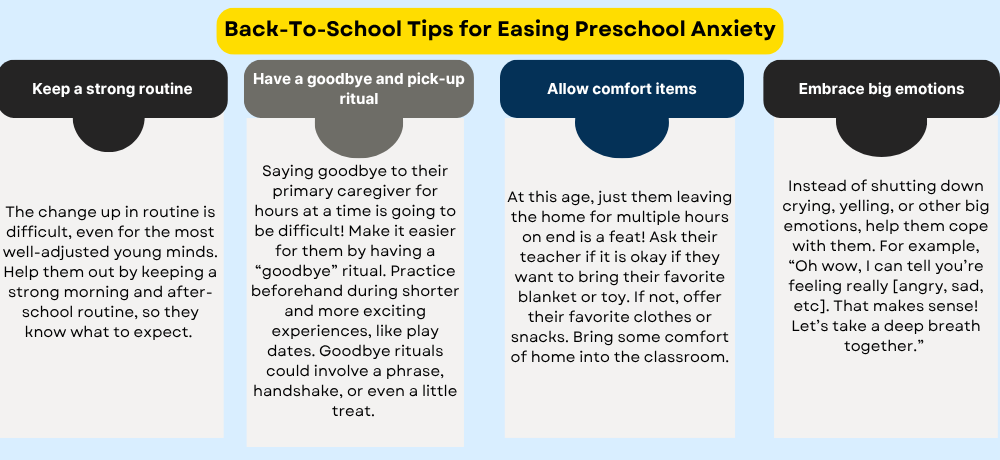
Back-To-School Tips for Easing Preschool Anxiety
A child’s first time ever in school is a big deal! They’re probably feeling a lot of big emotions and aren’t sure how to handle them. If you have a child of 3 or 4 who is starting preschool for the first time and experiencing anxiety, here are some tips to help:
- Keep a strong routine: The change up in routine is difficult, even for the most well-adjusted young minds. Help them out by keeping a strong morning and after-school routine, so they know what to expect.
- Have a goodbye and pick-up ritual: Saying goodbye to their primary caregiver for hours at a time is going to be difficult! Make it easier for them by having a “goodbye” ritual. Practice beforehand during shorter and more exciting experiences, like play dates. Goodbye rituals could involve a phrase, handshake, or even a little treat.
- Allow comfort items: At this age, just them leaving the home for multiple hours on end is a feat! Ask their teacher if it is okay if they want to bring their favorite blanket or toy. If not, offer their favorite clothes or snacks. Bring some comfort of home into the classroom.
- Embrace big emotions: Instead of shutting down crying, yelling, or other big emotions, help them cope with them. For example, “Oh wow, I can tell you’re feeling really [angry, sad, etc]. That makes sense! Let’s take a deep breath together.”
- Practice age-appropriate coping skills: Things like deep breaths, wiggle or dance breaks, and color scanning are all ways you can teach your child how to cope with big emotions in a healthy and safe way.
If problems persist, talk to a child therapist. Therapy modalities like play therapy are perfect for young children who may not be able to talk about what they’re feeling but who still have big emotions to express.
Separation Anxiety in School
Sometimes, fear of school extends beyond coping mechanisms and goodbye hugs. Separation anxiety is one of the most common childhood disorders, affecting around 4% of children.
If your child experiences separation anxiety, therapy is recommended as a treatment method. Treating separation anxiety quickly improves recovery rates. To talk with a child therapist today, contact Lifebulb. We have therapists trained to treat separation anxiety and school anxiety in children.

.webp)
.webp)
.webp)