
When you wake up, what’s the first thing you do? You probably reach for your phone. And in every spare moment after that, you probably want to do the same. Scrolling social media, shopping, eating sugary foods, and binge-watching TV all have something in common: They’re highly pleasurable and very easy to do. This also makes them highly addictive.
Most people understand that eating sugar and bed rotting while you scroll all day isn’t going to make you feel good. But it’s hard to stop engaging in activities that are not only easy, they feel good! To help them beat these behavioral addictions, some people have turned to a new wellness trend called “Dopamine Detox”.
But is a dopamine detox scientifically based? Does it work?
No, it’s not scientifically proven. But that doesn’t mean the idea behind it is entirely wrong. This article will debunk the myths surrounding dopamine detoxes and explain what you should do instead.
What Is a Dopamine Detox?
The goal of the dopamine detox is to refrain from engaging in the type of addictive behavior that we turn to all the time. This part of a dopamine detox is great. After all, replacing bad habits with good ones is a hallmark of many therapy models.
The science gets a little wonky, however, when it comes to how dopamine detoxes supposedly work. The theory is that by refraining from these addictive behaviors, you can detox your body from dopamine. In doing so, you teach your brain how to exist without the constant supply of dopamine you get from highly addictive activities.
The problem?
You can’t detox from dopamine. It’s not possible because dopamine is a neurotransmitter critical to the functioning of our bodies.
What Is Dopamine?
Dopamine is a type of neurotransmitter—a chemical messenger that helps transmit signals in the brain and throughout the nervous system. It plays a key role in several important functions, including:
- Mood and motivation: Dopamine is often called the “feel-good” chemical because it’s involved in the brain’s reward system. It helps regulate pleasure, motivation, and reinforcement of behaviors.
- Movement: Dopamine is essential for motor control. Low levels are linked to movement disorders like Parkinson’s disease.
- Focus and attention: It helps with concentration, decision-making, and regulating impulses.
- Learning and memory: Dopamine supports how we learn from rewards and consequences.
In short, dopamine helps us feel motivated, move our bodies smoothly, and stay focused. Some activities give us a lot of dopamine quickly—scrolling, eating sugary foods, gambling, etc. These are usually highly addictive.
Others give us longer, more sustained dopamine. Going for walks, sleeping, and eating food high in protein are all examples of healthy habits that increase dopamine in sustainable ways.
The goal of a dopamine detox is to move away from the behaviors that give us a quick hit of dopamine and towards the behaviors that provide long-lasting and sustainable dopamine.
This is a great goal! And it is possible. The dopamine detox just isn’t the most effective way to get there.
Does a Dopamine Detox Work?
So what does a dopamine detox do? Let’s do some quick myths and facts of a dopamine detox.
Myth: Dopamine Detox lowers levels of dopamine in your brain.
This is False. A dopamine detox will not lower the levels of dopamine in your brain, because dopamine is a crucial neurotransmitter.
Fact: Dopamine Detox helps you break bad habits.
This can be true. The point of a dopamine detox is to refrain from engaging in addictive behaviors, like social media or drinking alcohol. At its core, this abstinence can help break addictions.
That’s what a dopamine detox can actually do: help you break addictions. But it’s a bit like quitting smoking cold turkey. It’s painful, difficult, and not guaranteed to last.
Myth: A dopamine detox is a chemical reset in your brain.
No. A dopamine detox doesn’t do anything with the chemicals in your brain.
Fact: A dopamine detox can lead to a healthier lifestyle.
Absolutely, when used correctly and with other coping mechanisms, a dopamine detox could be part of the tools that help you break those bad habits. Just not because it resets dopamine levels in your brain. It works by changing behaviors and how we think about our behaviors.
What Is Dopamine Burnout?
“Now wait a minute,” you might be thinking. “If you can’t detox from dopamine, how is dopamine burnout possible?”
Dopamine burnout, or dopamine deficiency, is a medical condition where your body doesn’t produce enough dopamine. (Low dopamine levels are usually bad, which is why you wouldn’t want to detox from them in the first place!) Many mental health disorders, like ADHD and Depression, could be caused by low dopamine as well.
And it’s true that activities like scrolling can lead to dopamine burnout over time. When you constantly feed your brain a steady supply of easy dopamine, it will stop producing so much on its own. Over time, the base level of dopamine that your brain will produce goes down.
This is the fundamental problem that a dopamine detox is trying to solve, but it does so by changing habits, not lowering dopamine levels. You have to retrain your brain to produce dopamine on its own again.
How to Do a Dopamine Detox (The Right Way)
With all that said, is a dopamine detox entirely pointless? Not at all! Armed with the right knowledge and a comprehensive plan, a dopamine detox can be helpful.
Here are some tips:
- Expect a longer process: One dopamine detox a week with bouts of scrolling in between isn’t going to fix the issue. Instead, make a dopamine detox part of a larger plan.
- Replace bad habits with good habits: Ask anyone recovering from drug use, it’s nearly impossible to replace drinking with just nothing. Instead, they’ll stock their fridges with alcohol-free drinks. The mind and body need a replacement behavior. Don’t just do nothing on your dopamine detoxes, do something good for you.
- If you are struggling, reach out. A dopamine detox cannot fix mental health or physical health issues. Don’t wait for it to get worse. Reach out to a qualified professional today.
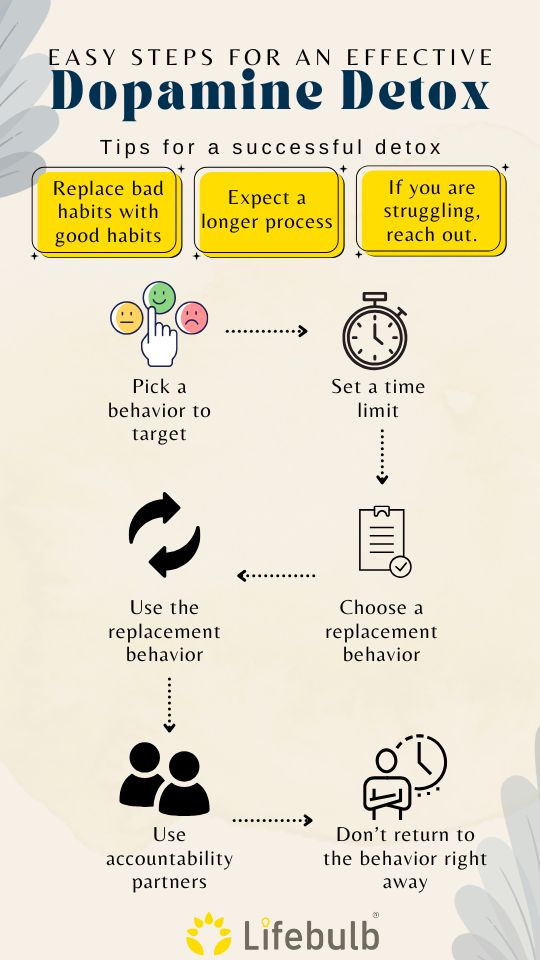
This is how you can do a dopamine detox the right way:
- Pick a behavior to target: This behavior should be highly addictive and something you want to do less of, or get rid of all together. For example, many people do a detox of social media. If you want to, you can pick two or three behaviors, but most scientists don’t recommend cutting out all of your bad habits at once. It increases the likelihood of relapsing into them.
- Set a time limit: How long will you go without this behavior? Choose something that feels reasonable. If a week is intimidating, do a day. If a day is too much, do a few hours. Even a few minutes is better than nothing. Choose something you know you can do.
- Choose a replacement behavior: If you’re not going to scroll, what else are you going to do? Remember that dopamine is not the enemy, it’s the quick-hit of dopamine that addictive behaviors produce that is the enemy. Crocheting instead of scrolling is a great solution. Talking with a friend, going for a walk, or trying a new recipe are also great. Stay away from the screen and anything that gives you the same feeling of scrolling.
- When you feel the urge, do your replacement behavior: Whenever you feel that itch to reach for your phone (or whatever you are detoxing from), do your replacement behavior instead.
- Expect it to be a little painful: Detoxing from anything addictive will have its withdrawal symptoms. Expect a little bit of mental pain, and push through it. Change up your replacement behavior if you have to, or call an accountability partner to keep you to your goal.
- Don’t return to the behavior right away: The timer goes off, and you’re free to engage in that addictive behavior again. If you can, wait just a little bit longer. Try to schedule an activity around the time your clock ends, so you can stretch it just a little. This will teach your brain that it can survive on less addictive behaviors, and give you the confidence to keep going.
The goal of dopamine detox is to detox from the addictive behavior. In this way, it’s similar to Cognitive Behavioral Therapy. (In fact, the person who coined dopamine detox used CBT techniques.)
A therapist can be instrumental in helping these good behaviors stick and purging bad ones. If you want the support of a trained professional, reach out to Lifebulb today. We have no wait times and accept most insurances. You can also browse our list of therapists near you.
.webp)
.webp)
.webp)
.webp)