
What’s your daily phone usage? You might be surprised to see 4 hours or higher. Although results vary based on the study, most studies agree that the average phone time of adults in the U.S. falls somewhere between 4 and 5 hours.
That’s a long time! But most people don’t want to spend that time scrolling. Many are desperate to find a way out. This article will help you identify doom scrolling in your life and put an end to it, once and for all.
What is Doom Scrolling?
The idea of “doom scrolling” was originally introduced during the 2020 COVID-19 pandemic. It described the behavior of consuming large amounts of negative or distressing news articles or user-generated content. When the whole world was in shutdown, doomscrolling started as a way to keep up to date, and ended as a compulsive need to consume more negative media or news.
Nowadays, some people use “doom scrolling” more widely. For example, doom scrolling before bed to procrastinate sleeping (and facing the work day that follows).
In this article, we’ll generalize doom scrolling as consuming large amounts of short-form content on social media apps, usually with the goal of distracting or dissociating, and with the result of feeling anxious, stressed, gross, or dissociated.
Why Do I Doom Scroll So Much?
You might feel like you have to doom scroll, or like you can’t look away. Why is that? Turns out, there are scientific reasons why you can’t stop doom scrolling:
- You’re looking for confirmation: You feel terrible about something, and you want to feel affirmed in that feeling.
- It’s a habit: In the same way that reaching for a cup of coffee every morning is a habit, your brain craves your phone habitually.
- It’s a maladaptive coping mechanism: You turn to your phone when you’re stressed, angry, sad, or lonely. Now it’s the only way you know how to deal with these distressing emotions.
Social media sites are designed to be addictive, so it makes sense if you feel like you can’t stop. Show yourself some compassion today.
Why Is Doom Scrolling so Addictive?
It can feel like you can’t stop, no matter how deep into a doom scroll you get or how bad you feel while doing it. It’s a trainwreck you can’t look away from.
This isn’t entirely your fault. For one, social media sites are designed to be addictive. From the short form content, to the way the algorithm always has an interesting-to-you video loaded and ready to go, to the sounds, trends, and comment sections filled with both hate and love… all of it tells your brain “keep going, this is interesting!”
Social media addiction is a real, recognized condition by many mental health professionals. (Although it’s not officially recognized in the DSM-5 yet.)
If you’re struggling with social media addiction or doom scrolling, talking to a therapist can help. This is a serious condition that can lead to even more serious conditions down the road. Take the first step towards healing today.
How to Stop Doom Scrolling For Good
There are two skills you need to develop to get off (and stay off) your phone: how to pull yourself out of a doom scroll, and how to prevent yourself from reaching for your phone in the first place.
Let’s look at the steps to accomplish each of these.
How to Get Out of a Doom Scroll Session
You look up from your phone to find that three hours have passed. Your brain feels foggy, your body heavy, and you’re dissociating heavily. But there’s still enough time in the day to do something, if only you can put the phone down and get out of this brain-fogged state. What can you do?
Stopping a doom scroll session is almost as important as preventing it in the first place. Being able to pull yourself out of doom scrolling and get back into productivity will prevent shame spirals and all-or-nothing thinking.
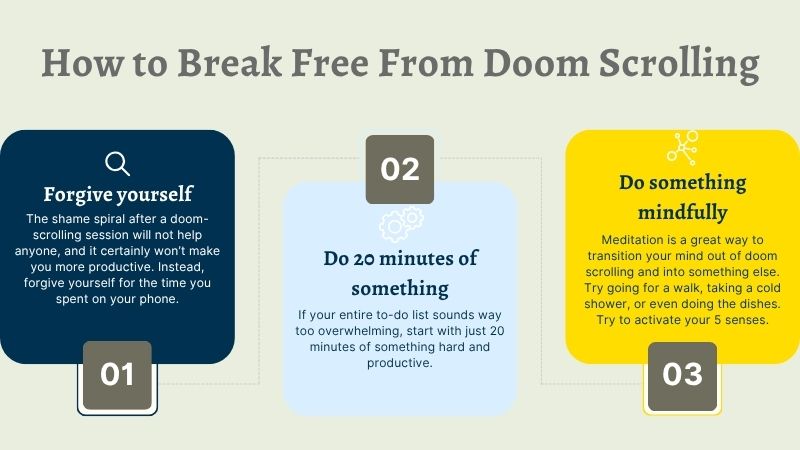
Here are some steps to stop a doom scroll session:
- Forgive yourself: The shame spiral after a doom-scrolling session will not help anyone, and it certainly won’t make you more productive. More often, that shame is only going to result in more doom scrolling. Instead, forgive yourself for the time you spent on your phone. Put it in the past, and make a plan to do better in the future.
- Do 20 minutes of something: If your entire to-do list sounds way too overwhelming, start with just 20 minutes of something hard and productive. Throw your phone across the room, start a timer on your computer or watch, and get to work for 20 concentrated minutes. After the 20 minutes are over, reassess. Do you still want to doom scroll? What do you want to do instead? Can you keep going with this project, or do you need to switch to something else to keep the momentum going?
- Do something mindfully: Meditation is a great way to transition your mind out of doom scrolling and into something else. If you don’t like meditation, try doing something else mindfully, like going for a walk, taking a cold shower, or even doing the dishes. Try to activate your 5 senses.
Prevention is always the best way to stop doom scrolling; let’s take a look at some strategies to prevent doom scrolling from happening.
How Do I Stop Doom Scrolling?
If you want to break the habit of doom scrolling altogether, you need a plan, accountability, and replacement behaviors.
A replacement behavior is a good, or sometimes neutral, action that will replace the maladaptive behavior you’re trying to stop. For many people, social media scrolling is a behavioral addiction. Your body is addicted and used to the action of scrolling. It’s still going to crave that action even after you stop. Adding in a replacement behavior, like going for a walk, reading, or even just looking through old photos instead of social media, will help your body adjust.
Here are some steps you can take to build a life in which you’re not doomscrolling for hours on end:
- Choose a replacement behavior: Whenever you want to scroll, do this behavior instead. It could be getting up to clean something, listening to music, calling a friend, or eating something sour (which can reduce anxiety, a good trick if anxiety is one of your biggest triggers.)
- Start with one tiny step: Habits are built one small step at a time. And that step can be small; it can even be tiny. For example, if you know you don't scroll a lot in the morning when you wake up, make it your goal to get up and do the first step in your goal. This could be as simple as opening your emails and looking at the emails you have to respond to later, or walking to the kitchen table, or writing one sentence for an essay (or even one word). What’s the smallest step you can take towards your goals? Do that instead of doomscrolling.
- Hold yourself accountable: There are plenty of accountability apps you can use to prevent doom scrolling. Blocking apps and websites, using online accountability apps like Focus Mate, or calling a friend while you work so you won't to get distracted are all proactive ways to stop doom scrolling.
Start small and celebrate the small wins. Bringing your phone intake down by 10 minutes a day is a win. Next week, try for 20! The goal does not have to be quitting cold turkey. Gradually getting to your goal is a great way to ensure you don’t burn out or return to social media.
Remember to focus on building healthy habits as you quit doomscrolling. And if you need help, Lifebulb Therapy is here for you. We have therapists who are available to talk and who accept most insurances.
Ready to make a positive change in your life? Start today, with Lifebulb.
.webp)
.webp)
.webp)
.webp)