
Gestalt therapy is a form of humanistic or person-centered therapy that brings the focus of a therapy session into the present moment. Instead of focusing on what happened to you in the past, it asks questions like: What are you feeling right now? Why are you feeling that way? What can you do to further your emotional and mental health in this moment?
Gestalt therapy is less common than other therapy methodologies like Cognitive Behavioral Therapy. Although it has been researched and proven effective, the research pool is limited, and most therapists agree that more research needs to be done. Still, Gestalt Therapy can be very beneficial to people who need it, especially when combined with other techniques.
What Is Gestalt Therapy?
Gestalt therapy comes from the German word “whole” or “put together”. Its philosophy is that a person cannot be boiled down to one bad thing or one diagnosis, but instead must be viewed as a whole person consisting of a body, mind, emotions, and experiences.
In this way, it fits nicely into humanistic therapy, an evidence-based and very common therapy model. Many humanistic therapists utilize parts of Gestalt therapy in their sessions.
Gestalt therapy often takes a unique approach to therapy. Instead of simple talk therapy, a Gestalt therapy session might include role-playing, art, music, dance, or re-enactment. The goal is to lead the client into self-awareness of the present moment.
For example, instead of focusing on how you feel about something bad that happened to you a few years ago, Gestalt therapy may challenge you to bring that moment into the present through role-playing or reenactment and see how you feel about it today. In other words, how does the present-day you feel about things that happened in your past?
This level of self-awareness can be very helpful in getting people out of their own ways, so to speak, and giving them the tools to build a life they are truly excited about living.
Gestalt Therapy Techniques
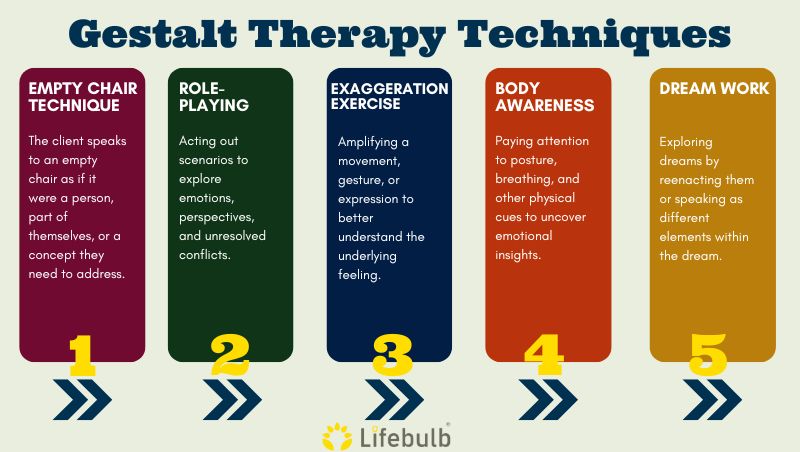
The goal of Gestalt therapy is to identify reasons why people are not self-aware, either by choice or not by choice. Once these reasons have been identified, Gestalt therapy seeks to break them down and nurture authentic self-awareness.
Some ways Gestalt Therapy techniques that accomplish this include:
- Empty Chair Technique – The client speaks to an empty chair as if it were a person, part of themselves, or a concept they need to address.
- Role-Playing – Acting out scenarios to explore emotions, perspectives, and unresolved conflicts.
- Exaggeration Exercise – Amplifying a movement, gesture, or expression to better understand the underlying feeling.
- Focusing on the Here and Now – Bringing awareness to present thoughts, emotions, and physical sensations rather than past or future events.
- Guided Fantasy/Visualization – Using imagery to explore feelings, relationships, or personal challenges.
- Body Awareness – Paying attention to posture, breathing, and other physical cues to uncover emotional insights.
- Dialogue Exercises – Engaging in a conversation between conflicting parts of the self (often using the empty chair). This is very similar to Internal Family Systems.
- Dream Work – Exploring dreams by reenacting them or speaking as different elements within the dream.
- Reversal Technique – Acting out the opposite of a behavior or feeling to reveal hidden emotions.
Gestalt Therapy stresses the importance of emotional expression, not just talking about our emotions. Although talking about our sadness, anger, or grief can be helpful, emotional pain will continue until we can express it. That’s why many of these techniques focus on activities that express emotions.
These are only some of the techniques used in Gestalt Therapy. Many therapists will choose elements of Gestalt therapy to use in conjunction with other therapy techniques.
Who Should Not Use Gestalt Therapy?
There are some drawbacks to Gestalt Therapy. It might not be a good option for people who:
- Need structured therapy sessions: Gestalt is more experimental and free-form in nature, and therefore might not be a good option for people who are looking for a more structured approach.
- Want to explore their past: The emphasis on the present may not be helpful for clients who want to explore and process events that happened in their past. (We recommend Psychoanalytic or Psychodynamic Therapy for that.)
- Feel uncomfortable committing to the exercise: The techniques used in Gestalt Therapy are unique. If you read the above list and felt yourself cringing away from it, Gestalt Therapy may not be the right choice for you. Although we encourage you to push yourself when it comes to trying therapy. Discomfort is where the growth happens.
Gestalt therapy isn’t for everyone. Talk to your therapist if you feel uncomfortable about the techniques they use in therapy. A good therapist will adjust their treatment plan accordingly. (If they don’t, that could be a therapist’s red flag.)
Who Should Use Gestalt Therapy?
Gestalt therapy is a good option for people who want to focus on how they feel in the present moment, with an emphasis on how self-awareness can change their life for the better. It can be helpful in improving anxiety, depression, low self-esteem, and relationship issues, among other things.
If you think Gestalt Therapy could be a good option for you, contact Lifebulb Counseling and Therapy. We have therapists specializing in Gestalt Therapy who can meet with you. We accept most major insurances and have little to no wait time.
.webp)
.webp)
.webp)