.webp)
You’re driving along a two-way highway when suddenly you think, what if I swerved my car into oncoming traffic?
Horrified, you grip the steering wheel tighter. You would never do that! You don’t want to do that, so why did you think it?
You just had an intrusive thought.
Intrusive thoughts are unwanted, distracting mental thoughts, images, and scenarios that are obtrusive and persistent. They are a big part of Obsessive Compulsive Disorder (OCD), but they can be a part of other disorders as well.
Intrusive thoughts are highly distressing and, at their worst, can be debilitating. If you struggle with intrusive thoughts, read this article to learn how to get rid of them.
What Are Intrusive Thoughts?
Intrusive thoughts are often violent, disgusting, or horrible. They do not reflect the true or hidden desires of the person thinking about them. They are not a reflection of want, need, or curiosity.
You are not a bad person for having intrusive thoughts.
They are intrusive—unwanted and disturbing to the person experiencing them.
We’ll get into examples below, but some signs the thought is intrusive include:
- It feels unwanted or unwelcome — the thought pops up without you choosing it.
- It clashes with your values or identity — it feels “not like you” or opposite to what you believe.
- It causes distress, anxiety, guilt, or shame rather than clarity or motivation.
- You don’t want to act on it — in fact, the idea of acting on it feels upsetting.
- It repeats despite efforts to ignore or suppress it.
- It shows up suddenly or out of context, often during calm or neutral moments.
- You try to analyze, neutralize, or “cancel” it (through reassurance-seeking, mental checking, or rituals known as compulsions).
- It feels urgent or sticky, demanding attention even though it’s unhelpful.
- You judge yourself for having it (“Why would I think this?”).
- It becomes stronger the more you fight it.
Remember, having an intrusive thought says nothing about your character or desires. The only thing it might point towards is an underlying mental health issue, like OCD, trauma, or anxiety.
Intrusive Thoughts Examples
Intrusive thoughts can range from uncomfortable to disgusting and horrifying. It’s important to label these experiences as intrusive thoughts, though, because the label takes away some of the thought’s power.
Intrusive thoughts have no power to change your actions, morals, beliefs, values, or character. Only you can change those things.
If you experience any one of these intrusive thoughts, remember that they are nothing but that: thoughts. Although they can be tricky to get rid of, with the right support and treatment plan, it is possible.
Examples of intrusive thoughts include:
- The thought of hurting a baby or child. Nearly half of all new parents have intrusive thoughts about purposefully harming their own baby, even though it is the last thing they would ever do.
- You’re cutting up a vegetable and suddenly think about stabbing yourself with the knife. Self-harm intrusive thoughts can happen whether or not you’ve engaged in self-harm in the past.
- You pass a stranger on the street and think about screaming at them or kissing them. Thoughts of random outbursts can come from nowhere and leave you shaken.
- You’re halfway to work when you wonder if you left the stove on and are consumed with a mental image of your house burning down. These sorts of “doubting intrusive thoughts” can be mild or severe.
- You’re falling asleep next to your loved one and suddenly imagine waking up to their dead body. Intrusive thoughts about losing your loved ones are very common and often stem from a fear of losing them.
- You’re giving a presentation at school and suddenly imagine a situation in which you pull your pants down or do something else humiliating and/or embarrassing. You would never do something like that, but you can’t shake the mental image of it happening.
Common categories of intrusive thoughts include:
- Self-harm
- Harming others
- Intrusive sexual thoughts, especially taboo ones
- Catastrophic thoughts, like people you love dying or a house fire
- “Doubting” intrusive thoughts, like wondering if you forgot to turn off the oven
- Reminders of past trauma, similar to flashbacks
People experience these thoughts without wanting to do them.
How to Stop Intrusive Thoughts
Intrusive thoughts are more common than you might think, with around 90% of people experiencing them. Most of the time, they are mild or infrequent. In some cases, they might be deeply disturbing and more frequent, but the person experiencing them is able to cope with them.
Other times, intrusive thoughts can spiral into anxiety, dread, and panic attacks. Obsessive behaviors seek to neutralize the thought. Obsessions can include checking, counting, repeating, or other ritualistic behaviors.
When obsessions and intrusive thoughts occur together, it is likely a sign of OCD. Treatment for OCD is highly specific to the disorder and the unique presentation of it in the client. Talk to a therapist if you think you have OCD.
Not sure if what you’re experiencing is OCD? Take this free OCD screening.
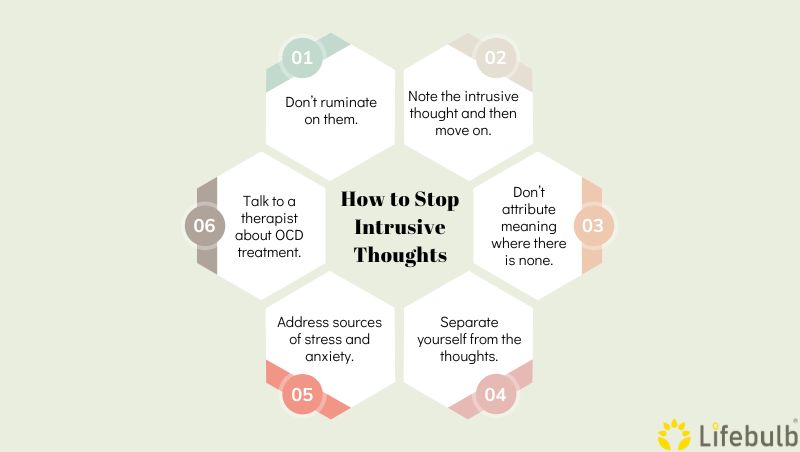
It might be possible to stop intrusive thoughts on your own, too. Here are some ways to do so:
- Don’t ruminate on them: Thinking about intrusive thoughts often gives them more power. You can’t reason with or logic your way out of an intrusive thought because they are, by nature, illogical.
- Note the intrusive thought and then move on: If someone tells you to not think about a white elephant, you’ll probably start thinking about a white elephant. Instead of trying really hard to not think the intrusive thought, imagine the thought like a particularly loud car passing by you. It’s uncomfortable, but it will pass.
- Don’t attribute meaning where there is none: The only deeper meaning that an intrusive thought holds is that you might be more stressed out than normal. Intrusive thoughts tend to get worse in periods of stress and anxiety. Other than that, there’s no deeper meaning to your desires or thoughts. They are not a reflection of who you are.
- Separate yourself from the thoughts: You can’t control the intrusive thoughts that come up. They're not up to you, so don’t put any personal weight on how often they occur.
- Address sources of stress and anxiety: Reducing sources of stress, using good coping mechanisms, and practicing healthy lifestyles are all ways to naturally reduce the frequency of intrusive thoughts.
If your intrusive thoughts are connected to OCD or any other mental health disorder, these coping skills might not be enough. Getting to the root of the issue by treating the disorder is the best way to treat intrusive thoughts.
If you would like help dealing with intrusive thoughts, reach out to Lifebulb Therapy. We have counselors near you who are ready to help. Choose from our therapist directory or give our team a call. We offer both in-person and online therapy and accept most major insurances.
.webp)
.webp)
.webp)
.webp)