.webp)
Men are more likely to be diagnosed with ADHD than women, but recent research shows that women are chronically underdiagnosed with ADHD.
Best estimates put the prevalence of adult ADHD (ADHD that persists in adulthood) around 3.1% globally, although other studies put that number as high as 5%. Within this group, men are diagnosed more frequently than women. This is largely because the stereotypes around ADHD—extreme hyperactivity, social disturbances, and inability to sit still—are attributed to men.
Women, who are socialized differently from men starting from a very early age, tend to exhibit more inattentive ADHD symptoms or mask their ADHD symptoms with coping mechanisms that can lead to anxiety later on in life.
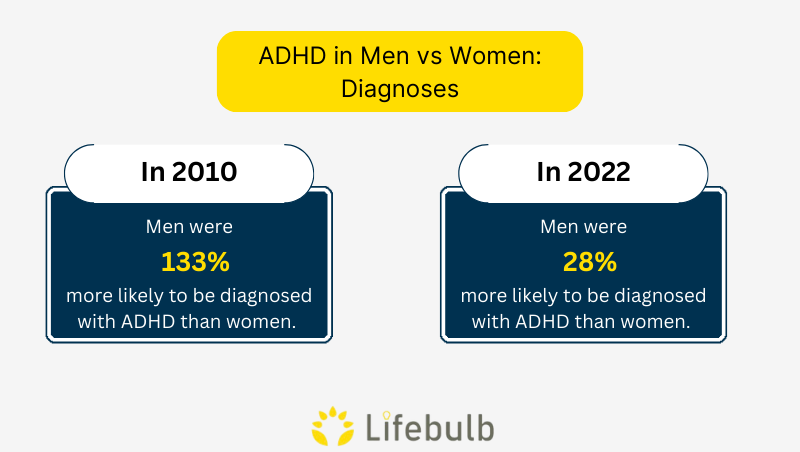
In 2010, men were 133% more likely to be diagnosed with ADHD than women, but that number is changing. As knowledge of how ADHD presents in women becomes more accepted, the difference between women's and men's diagnoses has shrunk: in 2022 men were only 28% more likely to be diagnosed with ADHD.
This article will cover what ADHD symptoms in women look like, how to get tested for ADHD as an adult woman, and what treatment for ADHD in women looks like.
ADHD Symptoms in Women
As children, girls with ADHD may be called “daydreamers”, “quiet”, or “in their own head”. Teachers may praise her cooperation while stating that if she could just apply herself a little more, she would reach her full potential.
The ADHD symptoms are hidden (commonly called “masked”), making it less likely that teachers and parents will seek a diagnosis. Sometimes, it can take decades for women to get their ADHD diagnosis.
There are three types of ADHD:
- Inattentive: Trouble focusing and staying on task, frequently daydreams or is lost in their head.
- Hyperactive-Impulsive: Difficulty staying still and is frequently restless, feeling as if they have to move.
- Combined: Both types.
ADHD in women will look different than in men.
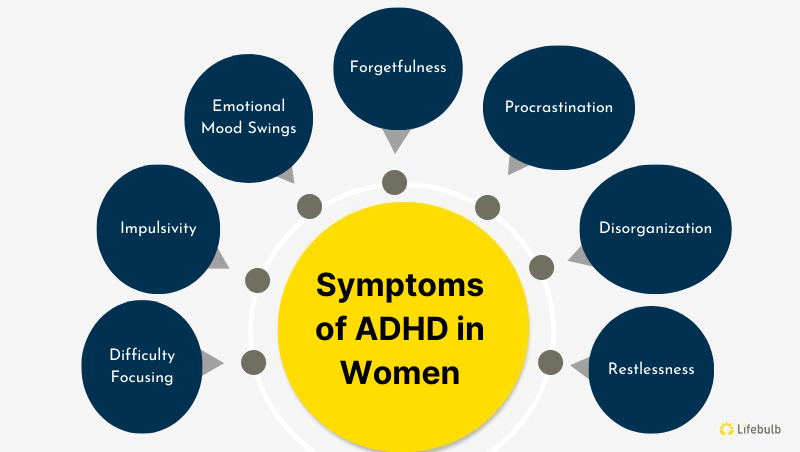
Inattentive Symptoms of ADHD in Adult Women:
- Difficulty sustaining attention on tasks or conversations
- Frequently losing or misplacing items (keys, phone, paperwork)
- Trouble following through on instructions or finishing projects
- Easily distracted by external stimuli or internal thoughts
- Forgetfulness in daily activities (appointments, chores, deadlines)
- Avoiding or procrastinating tasks that require sustained mental effort
- Struggling with organization and time management
Hyperactive-Impulsive Symptoms of ADHD in Adult Women:
- Feeling restless or “on edge” much of the time
- Difficulty sitting still for long periods (e.g., at work or during meetings)
- Talking excessively or interrupting others frequently
- Impulsive decision-making or difficulty delaying gratification
- Feeling impatient in situations requiring waiting
- Acting without considering consequences, such as overspending or blurting out thoughts
- Fidgeting, tapping, or other physical manifestations of restlessness
Adult women with ADHD may present differently than men, often showing more internalized symptoms like mental restlessness, perfectionism, or emotional sensitivity, which can make the condition harder to recognize.
ADHD in Women vs ADHD in Men
It’s not that ADHD symptoms are different in women than they are in men; ADHD is still ADHD. However, they will present differently in women because of different societal expectations and different social conditioning.
Women Are More Likely to Have Inattentive ADHD
Women are more likely to mask hyperactivity symptoms under the social standard of being polite and socially acceptable. Women, in general, are expected to be less disruptive than men, and so they might not exhibit as many hyperactive or impulsive behaviors.
Women are also more likely to have inattentive ADHD than hyperactive-impulsive.
ADHD Effects Men and Women Differently
Men with untreated ADHD are more likely to be disruptive, hyperactive, and aggressive. Women are more likely to be anxious, depressed, lonely, and struggle with self-esteem.
Both of these again come down to the differences in how young boys and girls are expected to behave. Both experiences can have profound impacts on mental health.
ADHD Can Take Longer to Manifest in Women
In general, boys are more likely to experience ADHD from a younger age, whereas girls develop it later in adolescence. This can also make it difficult for women to get a diagnosis, as they may have appeared perfectly “normal” until later in their lives.
What are the symptoms of high-functioning ADHD in women?
High-functioning ADHD is not a clinically recognized term, but is used to describe people who have less severe ADHD.
People with high-functioning ADHD may be able to manage their symptoms on their own to a certain extent, but are often at risk for developing burnout, depression, and anxiety. While their ADHD symptoms may not be as disruptive as others, they still have a big impact on them.
Symptoms of high-functioning ADHD in women include:
- Succeeding in school or at work while struggling with organization and time management behind the scenes.
- Often taking on too many work, social, or family responsibilities and feeling overwhelmed.
- Getting deeply focused on projects that interest them while ignoring other important tasks.
- Being chronically late or having trouble meeting deadlines, even when they can complete tasks.
- Keeping a polished or "put-together" appearance while feeling scattered or anxious inside.
- Forgetting appointments, misplacing items, or losing track of personal belongings.
- Relying heavily on planners, reminders, or digital tools to stay organized.
- Feeling socially anxious or self-critical about missed details or perceived shortcomings.
- Experiencing emotional sensitivity, mood swings, or impulsivity, often hidden behind their professional demeanor.
- Thriving in creative or high-energy tasks but struggling with boring, routine, or detail-oriented work.
This is not a complete list, and your experience with high-functioning ADHD may be different.
What are the symptoms of undiagnosed ADHD in women?
Women can go years without being diagnosed. Some women are far into their adulthood before realizing the things they've been struggling with all their lives aren’t a personal failure, but a sign of ADHD.
Symptoms of undiagnosed ADHD include:
- Chronic forgetfulness or losing track of tasks and belongings
- Difficulty focusing, completing tasks, or managing time effectively
- Feeling constantly overwhelmed or disorganized
- Emotional sensitivity, mood swings, or frequent frustration
- Procrastination or avoidance of tasks that require sustained effort
- Restlessness or difficulty relaxing, even in downtime
- Struggling with self-esteem due to perceived underperformance or “scatterbrained” behavior
If you think you have ADHD, you can take this free online ADHD test to be screened for symptoms. You can also talk to an ADHD therapist.
What Can ADHD be Mistaken for in Women?
As children, girls with ADHD may be told they are quiet, shy, or daydreamers. They may be praised for their good behavior while simultaneously told to focus harder. Their parents and teachers may do so in good faith, unknowing that the effort it already takes to focus on the tasks at hand is immense.
This is why many girls with ADHD grow up to have anxiety disorders. When the anxiety starts to show, this is when they go to doctors and therapists and get the diagnosis, almost a quarter of women will get at some point in their lifetimes: Anxiety.
Anxiety is commonly comorbid with depression (meaning it’s common for women to have both anxiety and depression), and may also stem out into an eating disorder or OCD.
Although all of these are serious disorders that need to be addressed, women who recognize the previously mentioned symptoms should consider seeking an ADHD diagnosis as well, as that might be the root of their mental health struggles.
How to Get Tested for ADHD As an Adult Woman
If you are an adult woman seeking an ADHD diagnosis for the first time, you have two options:
- Talk to your doctor for a referral. Most doctors will be able to refer you to a psychiatrist or diagnose you themselves. However, they will not be able to provide talk therapy or continuous support (except through medication management), so women looking to address their ADHD in ways other than medication should also seek out option 2.
- Talk to a therapist: All licensed therapists and social workers can diagnose ADHD in women. Depending on their specialty and focus, most therapists will also treat ADHD through any of the treatments mentioned below.
It can be a long and tiresome process getting diagnosed with ADHD as an adult. You may be told that you don’t have it, get wrongly diagnosed with anxiety time after time, or may just be put on medication. (Medication can work for many people, but it’s not a perfect solution for everyone.)
Listen to your gut; if you recognize the symptoms of ADHD in yourself, seek a therapist who understands you and will help you.
What Is the Treatment for ADHD in Women?
ADHD treatment for women can differ from that of men. In part because women can exhibit different symptoms, but also because they have been socialized differently. Our childhood experiences play a big role in our current mental health. It’s important to understand how growing up undiagnosed affects your thought, behavioral, and emotional patterns.
Treatment options for women include:
- Medication: Psychiatrists may prescribe stimulant or non-stimulant medications to help manage ADHD symptoms in adult women. These medications can improve focus, attention, and impulse control.
- Therapy: Cognitive-behavioral therapy (CBT) or psychoeducation can be beneficial for women with ADHD. Therapy sessions can help develop coping strategies, improve time-management skills, and address emotional challenges related to ADHD.
- Lifestyle Changes: Implementing healthy habits such as regular exercise, a balanced diet, and sufficient sleep can have a positive impact on managing ADHD symptoms in adult women. Exercise and getting out into nature especially have been proven to be good for ADHD management.
- Mindfulness and Meditation: Practicing mindfulness techniques and meditation can help women with ADHD improve self-awareness, reduce stress, and enhance concentration. Meditation isn’t suited for everyone, but try some of these easy mindfulness techniques to center yourself and reduce the stress of living with ADHD.
- Support Groups: Joining support groups or seeking out community resources can provide adult women with ADHD the opportunity to connect with others facing similar challenges, share experiences, and gain valuable support. Online support groups can foster a community of support that understands what you are going through.
- Structured Routines: Routine isn’t easy to establish with ADHD, but when used correctly, routine can help women with ADHD stay organized, manage their time effectively, and reduce forgetfulness. Find a technique that works for you, like an online calendar, sticky notes, color-coordinated reminders, or simply sharing a calendar with a friend so they can hold you accountable.
Remember, seeking treatment and support is a proactive step towards improving your well-being and living a brighter life. Each individual is unique, so it's essential to work with healthcare professionals to tailor a treatment plan that meets your specific needs and goals. You're not alone on this journey—empower yourself to take action and explore these treatment options to thrive with ADHD.
This is not a complete list of treatments, either. Once in therapy, your therapist will determine the best modality to fit your needs. This might include CBT, ACT, Narrative therapy, or DBT.
If you want to start ADHD therapy soon with a therapist who understands where you’re coming from, search Lifebulb’s directory of therapists. We offer online ADHD treatment with therapists who can diagnose adult ADHD. We also have short wait-times and accept most insurances. Don’t wait another year or two to get the diagnosis and treatment that you deserve.
.webp)
.webp)

-(1).webp)