
When it comes to your mental health, there are many different treatment paths you can take to stay healthy. You might see a therapist for talk therapy and a psychiatrist for medication, but these aren’t the only health professionals who can help you.
Understanding what type of medical professionals can help you and how to find them is important, especially when a shortage of doctors is making it difficult for many people to find care.
If you’ve been stuck on a waiting list for months and are looking for another option to get your mental health treated, a Nurse Practitioner might be a good choice for you.
NP vs MD: Key Differences
Both medical doctors and nurse practitioners (NPs) are trained professionals with education and experience in identifying and treating illnesses and ailments. The difference is that doctors undergo more rigorous and longer education periods. Nurse practitioners are not doctors, but that doesn’t mean nurse practitioners aren’t knowledgeable or helpful. NPs are in a unique position to help people that doctors can’t, and to fill the gap between psychiatrists and medical doctors.
In 27 states, nurse practitioners have full practice authority and can act as primary care providers. This means they can diagnose and treat conditions, order tests, and discuss treatment plans with you.
The states in which an NP can act as a primary care provider are:
- Alaska
- Arizona
- Colorado
- Connecticut
- Delaware
- Hawaii
- Idaho
- Iowa
- Kansas
- Maine
- Maryland
- Massachusetts
- Minnesota
- Montana
- Nebraska
- Nevada
- New Hampshire
- New Mexico
- New York
- North Dakota
- Oregon
- Rhode Island
- South Dakota
- Utah
- Vermont
- Washington
- Wyoming.
Other states allow NPs to act with “reduced practice authority”, usually meaning they are restricted in their duties in at least one way or must work with another health care provider to administer treatment.
Educational Differences
Both NPs and Doctors undergo rigorous education requirements. NPs must earn at least a graduate degree and complete a practicum in a clinical setting, along with completing numerous exams and certifications throughout the process.
Some NPs specialize in certain areas, which will require additional training and certification. For example, Psychiatric Mental Health Nurse Practitioners (PMNHPs) are specialized to diagnose and treat mental health conditions.
Doctors generally have stricter and longer education requirements, which include a 4 year long medical school and a residency training program.
What Do Nurse Practitioners Do?
Nurse Practitioners do most things that doctors do, either under the supervision of a doctor or on their own, depending on state regulations. Depending on their specialty and role, Nurse Practitioners may:
- Perform physical exams and wellness checks
- Administer primary and emergency care to patients
- Create patient treatment plans
- Prescribe medications
- Order and administer diagnostic tests
- Offer treatment advice and guidance
- Provide mental health support
Doctors may have a wider range of specialties and, therefore, a wider range of duties. In general, however, a nurse practitioner is well equipped to be a general primary care provider or mental health provider, depending on their specialization.
Nurse Practitioner vs Doctor Specialties
Both nurse practitioners and doctors can specialize in different areas. For example, common areas of doctor specialties include:
- Psychiatry and Mental Health
- Family Medicine
- Internal Medicine
- Pediatrics
- Obstetrics & Gynecology (OB/GYN)
- Surgery
- Dermatology
- Neurology
- Cardiology
Any many, many more. This is far from a complete list.
The specialties available to a nurse practitioner are a bit more limited due to their shorter educational requirements. However, with additional training and specialization, NPs can become specialized in:
- Family Nurse Practitioner (FNP)
- Pediatric nurse practitioner
- Orthopedic nurse practitioner
- Adult Gerontology Nurse Practitioner (AGNP)
- Psychiatric Mental Health Nurse Practitioner (PMHNP)
NPs with these specialties are highly knowledgeable in their field of study, and are a great resource for appointments, diagnosis, treatments, and medications.
Should I See an NP or a Doctor?
Does it matter if you see an NP or a doctor? It depends on your needs. NPs are qualified to meet many of your physical and mental health needs, but sometimes the highly specialized and trained eye of a doctor is needed.
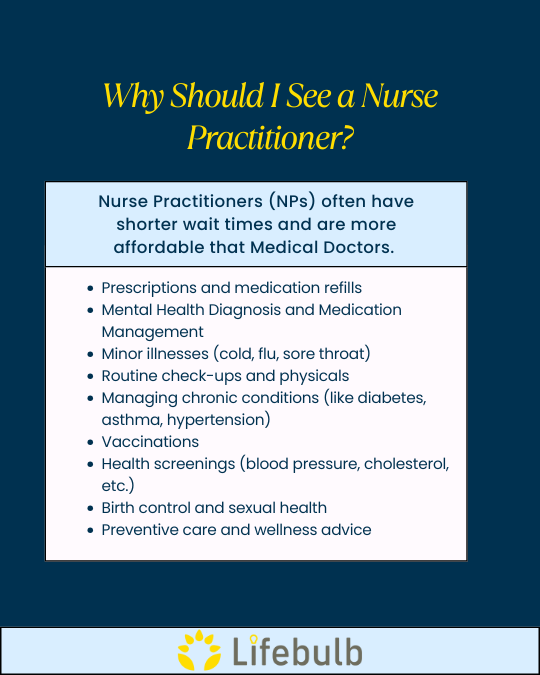
You should see a Nurse Practitioner (NP) for:
- Prescriptions and medication refills
- Mental Health Diagnosis and Medication Management
- Minor illnesses (cold, flu, sore throat)
- Routine check-ups and physicals
- Managing chronic conditions (like diabetes, asthma, and hypertension)
- Vaccinations
- Health screenings (blood pressure, cholesterol, etc.)
- Birth control and sexual health
- Preventive care and wellness advice
You should see a Medical Doctor (MD or DO) for:
- Complex or serious medical conditions
- New or undiagnosed symptoms that may need advanced testing
- Surgery or specialized procedures
- Specialist referrals (e.g., cardiology, neurology)
- Conditions not improving with initial treatment
- Second opinions for serious diagnoses
- Hospital care or emergency situations
Sometimes, a specialized nurse practitioner can substitute for a doctor. For example, a PMHNP can treat most mental health issues without the supervision of a doctor (depending on your state).
When looking for available health providers near you, check their credentials and specialties. A Nurse Practitioner may have more availability, and with the right speciality, they’ll have the knowledge and experience to provide expert care.
Why Should I See a Nurse Practitioner?
There has been a recent shortage of health professionals across America. Wait lists for primary care providers, psychiatrists, and other physical and mental health providers can stretch into months in the future. Prices have begun to rise, too, and insurance isn’t always keeping up with the rising price of visits.
There are many reasons to see an NP over a Doctor, and many situations in which this is a good idea. NPs are often more affordable than a doctor's visit, with shorter wait times.
If you need help, you likely need help now, not 2-3 months in the future. Nurse Practitioners can help bridge the gap between the demand for medical professionals and the number of doctors available.
If you are struggling with your mental health and would like to see a Nurse Practitioner who specializes in mental health, Lifebulb Therapy can help. We have PMHNPs who can treat mental health conditions, diagnose, and prescribe medication.
Don’t stay on a waiting list when there are qualified professionals ready and available to meet your needs. Contact Lifebulb to be scheduled with a Nurse Practitioner or therapist today.
.webp)

.webp)