
When it comes to productivity, a common piece of advice is “Just start with the first step.” This advice of just starting can be helpful, but it’s not so easy for everyone.
Task paralysis is a common symptom that people with ADHD experience. During Task Paralysis, a person with ADHD will feel unable to start a task. As a result, their whole productivity comes grinding to a halt. They can’t start the task they want to, but they also don’t feel like they can move on to something else. This can lead to chronic procrastination, missed deadlines, and feelings of guilt or shame.
Task paralysis can be frustrating, but it is also treatable. Let’s look at the definition, symptoms, and treatment options for ADHD Paralysis.
What is ADHD Task Paralysis?
ADHD is a neurodevelopmental disorder that affects attention, impulse control, emotional regulation, memory, and cognitive processing. These are all skills that rely on executive functioning skills, which people with ADHD have a much harder time using.
Nobody likes starting particularly unpleasant tasks. ADHD Paralysis is not just “I don’t want to do the dishes, so I’m going to scroll on my phone instead.” ADHD task paralysis affects tasks that are undesirable and desirable. It can also affect tasks that have a lot riding on them, like big work projects or bills.
Examples of ADHD task paralysis include:
- Sitting at your desk for hours, knowing you need to start a work project, but never opening the document.
- Staring at a pile of laundry, feeling unable to begin folding it.
- Wanting to clean the kitchen but not knowing where to start, so you do nothing.
- Needing to make an important phone call, but are overwhelmed and end up staring at the wall.
- Working on a less important task instead of opening an important email because you’re worried about what the email will say.
- Lying in your towel after a shower because the thought of finding clothes to wear sounds like too much.
- Delaying grocery shopping because the list-making and planning feel exhausting.
- Not starting an essay until you’ve researched every possible angle, have written extensive outlines, and color-coded everything. (Overanalyzing the task instead of beginning it.)
- Sitting on your bed in workout clothes for an hour instead of going to the gym because starting feels impossible.
The important thing to note in these examples is the freeze aspect of it. All things come to a screeching halt when task paralysis hits. You’re not doing something fun while you’re procrastinating. More often than not, you’re sitting and desperately telling yourself, “Just start it.”
When left untreated, ADHD task paralysis can be very disruptive to life, health, and basic functioning.
Call out: Do you think you might have ADHD? Take our free, online screening test here.
Symptoms of ADHD Task Paralysis
Here’s a list of common symptoms of task paralysis in ADHD:
- Feeling mentally “frozen” when starting a task, even if it’s important.
- Knowing what needs to be done but being unable to begin.
- Overthinking steps or possible outcomes until taking action feels impossible.
- Feeling overwhelmed by the size or complexity of a task.
- Avoiding the task entirely, sometimes without a clear reason.
- Experiencing guilt or shame about not starting.
- Getting distracted by unrelated activities instead of the intended task.
- Physical restlessness paired with mental inaction.
- Losing track of time while trying to “mentally prepare” to start.
- Needing external prompts, deadlines, or accountability to take action.
ADHD task paralysis comes with a lot of guilt and shame. If you’re experiencing task paralysis, know that there are treatment options and that this is not reflective of who you are as a person. Your brain might need a little more help in getting things started, and that’s okay.
At Lifebulb, our therapists can help you find coping mechanisms that work for you.
ADHD Paralysis vs Executive Dysfunction
If you have ADHD, you’ve probably heard the term “executive dysfunction” get tossed around. What’s the difference between executive dysfunction and task paralysis?
Executive dysfunction is a broad experience not limited to ADHD. It might refer to difficulty concentrating, remembering, controlling emotions, planning, and many other tasks. It can also lead to ADHD Paralysis. Task paralysis is a specific symptom that could be the result of executive dysfunction in a brain with ADHD.
What Are the Three Types of ADHD Paralysis
Task paralysis is not the only type of ADHD paralysis. Although not officially recognized medical terms, many people refer to three types of ADHD paralysis:
- Mental paralysis – Have you ever tried to listen to three songs at once? The lyrics crash into one another, and you lose the ability to track individual songs. This is what mental paralysis is like, but with thoughts. When the ADHD brain is unable to sort and organize all its many thoughts, it can get stuck and overwhelmed. Paralysis happens as a result.
- Task paralysis – This is when you know exactly what you need to do but feel unable to start, often due to the task feeling too big, boring, or stressful. It also might be a result of wanting or feeling like you need to do another task first, of not knowing where to begin, or of being overwhelmed in other areas of your life. It can feel like there are too many steps and you aren’t sure how to take the first one.
- Choice paralysis – When too many options or decisions make it impossible to choose a starting point, leading to inaction. People with ADHD may have a harder time making decisions than other people, because their brains equally consider all of the options. When you have too many choices, your brain may spend time analyzing each choice instead of making a decision, leading to paralysis.
Each one of these is a unique experience and requires unique coping skills, which we’ll talk about down below.
Does ADHD make me lazy?
No! From the outside, ADHD paralysis can look a lot like laziness. Someone who doesn’t understand you or ADHD might ask, “Why don’t you just do it?” Or say, “It’s not that hard. Just start it.” What they don’t understand is that for people with ADHD, it is that hard. ADHD paralysis can make it impossible to move forward until we clear that mental block. This does not make you lazy. And with the right tools, you can have that block cleared quickly and with minimal energy loss to you.
How can I get unstuck when you have ADHD task paralysis?
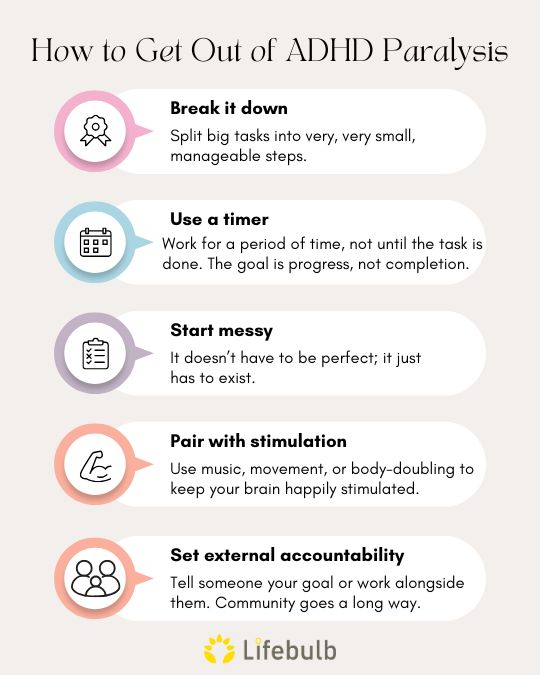
Let’s address how to get unstuck from ADHD Task Paralysis. These coping skills could also be useful for choice and mental paralysis, but we’ll discuss them in the context of task paralysis.
Here are some tips to cope with task paralysis. Put your own spin on them and adapt them to meet your needs:
- Break it down – Split big tasks into very, very small, manageable steps. Make the first step an easy win—as easy as opening your email and hitting “compose”, for example—and celebrate when you accomplish that one win.
- Use a timer – Instead of pressuring yourself to get something done, focus on the time spent on an activity. Give yourself an hour, or even just 10 minutes. Try to focus for that entire time, and then feel good about what you’ve accomplished, even if it’s not totally done yet.
- Start messy – Begin without worrying about perfection. Have the mindset of “I just have to get it out there. It doesn’t have to be perfect.” If you’re trying to do something physical, that means that you don’t have to do it perfectly. 10 minutes at the gym is better than an hour, so if you’re overwhelmed by your workout schedule, focus on just getting to the gym at first.
- Pair with stimulation – ADHD brains often struggle with feeling either under- or over-stimulated. Use music, movement, or body-doubling to keep your brain happily stimulated and your productivity at a sustainable level.
- Set external accountability – Tell someone your goal or work alongside them. Community goes a long way, both in helping you complete projects and overcoming bad moments. Getting caught in a shame spiral won’t help, and a community can help lift you out of it if you find yourself in one.
Therapy is also a good option for someone who finds themselves plagued by bouts of ADHD task paralysis. It’s hard when you know what you want and what you have to do to get there, but you just can’t seem to get yourself to take that first step. At Lifebulb, we understand. Our therapists are here to help. Contact our team or browse our list of therapists to find one near you.
.webp)
.webp)

-(1).webp)