
For most people, there’s a substantial gap between what they want to do and what they actually do. For example, you might want to quit your job, eat all the cake in your fridge, break off that relationship, or steal that fancy new watch you’ve had your eyes on. But most people have the impulse control to stop themselves from engaging in this potentially dangerous behavior.
Impulse control is the ability to stop yourself from following every single one of your impulses. As the common therapy saying goes, your feelings are always valid, but that doesn’t always make them right. You can have the urge to do something and at the same time, choose not to do it because it’s dangerous or otherwise doesn’t align with your values.
If you struggle with this, then you might have impulse control issues. Many people struggle with impulse control, both in adulthood and as children. It is often a sign of a mental health issue like ADHD, but it can also be a part of a larger Impulse Control Disorder. Let’s dive into the details below.
What Is Impulse Control?
Impulse control is part of our executive functioning, which is a set of skills the brain has to manage everyday tasks, plan for the future, and stay on track, among other things. Many mental health issues are linked to decreased executive functioning, including impulse control disorders.
Examples of Impulse Control in Adults
In adults, impulse control issues may look like:
- Frequent angry outbursts or aggression
- Difficulty delaying gratification
- Acting without thinking about consequences
- Risky behaviors like gambling, substance use, or unsafe sex
- Impulsive spending or decision-making
- Interrupting others or dominating conversations
- Feeling regret or guilt after impulsive actions
- Trouble focusing or planning ahead
- Low frustration tolerance or emotional outbursts
- Repeating harmful or self-destructive behaviors
For example, an adult with impulse control issues may:
- Get into arguments a lot
- Make major financial decisions, like buying a boat or purchasing a home, without thinking it through all the way
- Gambling away all their money
- Have a string of short relationships, because they can’t stop themselves from getting into and then ending a relationship
- Constantly speaks over their friends
These are just some examples of what impulse control issues may look like in an adult. See below for a specific list of impulse control disorders and related issues.
Examples of Impulse Control in Children
Some level of impulse control issues is to be expected with children. Their brains haven’t fully developed yet, and depending on their age, they may lack the understanding, experience, and ability to comprehend consequences, plan for the future, or think through their decisions. For example, a two-year-old is going to have much less control over their impulses than a six-year-old. When behavior is age-appropriate, it is not necessarily a sign of an impulse control disorder.
Still, many impulse control disorders start in childhood, so it’s important to be aware of the symptoms. Some symptoms of impulse control issues in children include:
- Frequent temper tantrums
- Interrupting or blurting out answers
- Trouble waiting their turn
- Acting aggressively or destructively
- Disregard of rules
- Sudden mood changes
- Engaging in risky or inappropriate behavior without thinking
For example, a child with impulse control issues may:
- Reach for a cookie right after you said, “Wait until after dinner for a cookie.”
- Climb on desks or other dangerous objects after being told to stop climbing on things.
- Crying and throwing their body down when they have to wait for their turn
- Getting angry, throwing things, or hitting when they are told to share, wait their turn, or compromise with others.
A child with impulse control issues will want everything to be their way, all the time. While this probably sounds like many young children you know, the difference is the true inability, or great difficulty, in controlling these impulses and the emotional outbursts that occur as a result.
If you think your child may have issues with impulse control, it’s worth taking them in for a behavioral evaluation. A child therapist will be able to see the nuances in your child's behavior and diagnose the root cause, along with providing a treatment plan that will help your child live to their full potential.
Impulse Control Disorders
Sometimes, impulse control issues stem from an Impulse Control Disorder (ICD). In the DSM-5, the handbook therapists use for diagnosing and treating disorders, there are five ICDs listed:
- Oppositional Defiant Disorder (ODD): A behavioral disorder in children and adolescents characterized by frequent anger, irritability, arguing with authority figures, and deliberate defiance or vindictiveness.
- Conduct Disorder: A more severe behavioral disorder in which children or adolescents consistently violate societal rules or the rights of others, showing aggression, deceitfulness, or serious rule-breaking.
- Intermittent Explosive Disorder: A mental health condition marked by repeated, sudden episodes of impulsive, aggressive, or violent behavior that is disproportionate to the situation.
- Kleptomania: A rare impulse control disorder where a person has a recurrent urge to steal items that are not needed for personal use or monetary value.
- Pyromania: An impulse control disorder involving repeated, deliberate fire-setting behavior, with fascination or gratification derived from fire and its consequences.
It is possible to have impulse control issues without having one of these disorders. For example, many people with Attention Deficit Hyperactivity Disorder (ADHD) also struggle with impulse control issues.
Do you think you might have ADHD? Take our free, online screening assessment for ADHD symptoms.
How to Control Impulsive Behavior in Adults
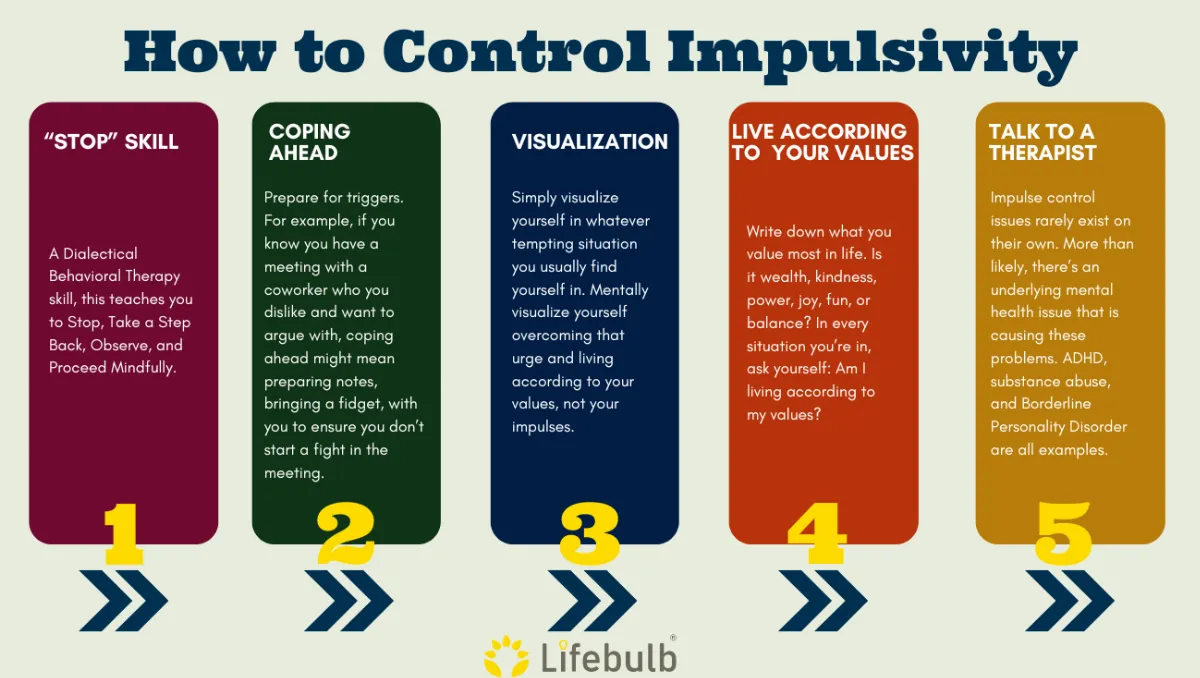
Struggling with impulse control can be frustrating. Many people experience a lot of grief, regret, and shame after giving in to their impulses. It’s not that people with impulse control issues are bad people, less kind, or less capable. Genetics and human biology play a big role in determining impulse control issues. Treatment and coping mechanisms can help you adapt to your brain and start living according to your goals and values, not the whims of your impulses.
Here are some coping mechanisms for impulsive behavior in adults:
- “STOP” skill: A Dialectical Behavioral Therapy skill, this teaches you to Stop, Take a Step Back, Observe, and Proceed Mindfully.
- Coping Ahead: Another DBT skill, the goal of coping ahead is to prepare for triggers. For example, if you know you have a meeting with a coworker who you dislike and want to argue with, coping ahead might mean preparing notes, bringing a fidget, or taking an accountability buddy with you to ensure you don’t start a fight in the meeting.
- Visualization: Mental visualization is a powerful tool. Olympic athletes use it to help them win races. Simply visualize yourself in whatever tempting situation you usually find yourself in. Mentally visualize yourself overcoming that urge and living according to your values, not your impulses.
- Write down your goals and values: We keep saying “live according to your values”, but what does that mean? Making decisions based on your values is an important therapy technique in Acceptance and Commitment Therapy (ACT). Write down what you value most in life. Is it wealth, kindness, power, joy, fun, or balance? In every situation you’re in, ask yourself: Am I living according to my values?
- Talk to a therapist: Impulse control issues rarely exist on their own. More than likely, there’s an underlying mental health issue that is causing these problems. ADHD, substance abuse, and Borderline Personality Disorder are all examples.
A therapist will help you get to the core reason behind your impulse control issues and treat the cause, not the symptoms.
If you’re ready to talk with a therapist, contact Lifebulb. We have therapists with open availability and little to no wait times.
How to Control Impulsive Behavior in Children
As a parent, impulse control issues in your children can be frustrating. You know they don’t mean any harm but are just struggling with their ability to handle and cope with stressful situations. What can you do to help?
Here are some parenting techniques that can help a child with impulse behavior issues:
- Don’t reward bad behavior: Let’s say your child throws a tantrum when they are told they have to share their toy. Instead of giving in and giving their toy back to them, hold your ground. Ensure everyone is safe, let the tantrum play out, and then offer choices. For example, “Do you want to play with a different toy, or wait 1 minute to play with this toy?” It’s okay if the waiting time is short to begin with. You can slowly increase it as time goes on and they grow more accustomed to regulating.
- Encourage good behavior: If you are out in public and your child willingly waits in line without you having to ask them, reward them with something they value. This might mean verbal praise, giving them a little treat, screen time, or something else.
- Avoid Violent Punishments: Use immediate, natural consequences instead. Younger children aren’t always able to correlate their behavior to consequences that occur later on. Instead, natural consequences (like not being able to play with the toy they really want to) are immediate and obviously correlated to their behavior, which will help them learn faster.
Many child therapists will also offer and recommend parenting therapy or therapy sessions where both child and parent are present.
Impulsive behavior in children can be exhausting and isolating, but you aren’t alone. Talk to Lifebulb Therapy about how we can help.