
Every day, we use our brains to help us manage daily tasks. We wake up and mentally plan our day, we do our work while ignoring the chattering of coworkers, and we pivot from failed plans.
For most people, these are natural behaviors; they don’t have to put much thought behind them. For others, simply making a plan for the day and sticking to it feels like an impossible task.
All of these tasks are controlled by our brain’s executive functioning. Executive dysfunction happens when those skills don’t work the way they should or need a little extra help to get there.
What is Executive Dysfunction?
Executive dysfunction is when you struggle with the mental skills that help you manage time, focus, plan, organize, and regulate emotions or behaviors.
What are the 12 executive functions of the brain?
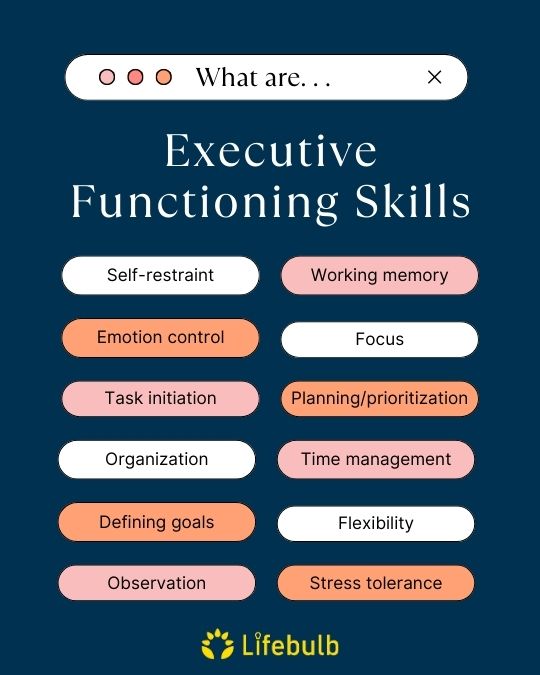
There are three main executive functions, but some researchers and professionals find it helpful to break them down into further categories.
The three main executive functions are:
- Working Memory: The temporary storage and processing of information. Whenever you get new information, it goes to the working memory. From there, the working memory will process it as it relates to your long-term memory. For example, if you learn something new about somebody, you have to add that new knowledge to your preexisting memory of them. That’s your working memory in action.
- Cognitive Flexibility: Cognitive flexibility is used when you need to adapt to change. For example, switching between writing an email and responding to a coworker who walked into the room, or realizing part-way through a project that your original solution won’t work and you have to switch gears.
- Inhibition Control: How well you control your emotions, thoughts, behaviors, and focus is determined by your inhibition control. For example, being able to block out the sound of a noisy coworker while you’re doing work, or being able to stay calm when you get annoyed at them are all skills that fall under inhibition control.
Beyond these, some practitioners break executive functioning skills into 12 categories:
- Self-restraint
- Working memory
- Emotion control
- Focus
- Task initiation
- Planning/prioritization
- Organization
- Time management
- Defining and achieving goals
- Flexibility
- Observation
- Stress tolerance
You can see how each of these skills could fit into the three main categories discussed above.
When someone struggles in these skills, they have executive dysfunction.
What are the symptoms of executive dysfunction?
There are many different signs of executive dysfunction depending on where you struggle and how severe the dysfunction is. Some symptoms are:
- Difficulty starting tasks (even simple or familiar ones)
- Procrastination, often due to overwhelm or indecision
- Trouble with time management, such as being late or losing track of time
- Inability to prioritize tasks effectively or focus on what's most important
- Easily distracted or frequently losing focus
- Struggling to switch between tasks or shift attention (also called “task switching”)
- Forgetfulness, such as missing appointments, deadlines, or where you placed things
- Disorganization, both physically (cluttered space) and mentally (scattered thoughts)
- Poor planning skills, leading to incomplete or rushed work
- Trouble following multi-step directions or breaking tasks into smaller steps
- Emotional dysregulation, such as overreacting to stress, frustration, or criticism
- Impulsivity, like interrupting, rushing decisions, or difficulty waiting your turn
- Low motivation, even for tasks that are necessary or previously enjoyed
- Difficulty finishing tasks, especially without external pressure or deadlines
This is not a complete list, and you might have other symptoms than these listed. Take a look at the list of executive functioning skills above. Do you find it easy or difficult to engage in those skills? If you find most of them difficult, you likely have executive dysfunction.
Is ADHD the same as executive dysfunction?
No. ADHD and executive dysfunction are closely connected but are separate things. Many people with ADHD struggle with their executive functioning skills, but it is possible to have executive dysfunction without having ADHD. One example is Autism; many people on the autism spectrum struggle with certain executive functioning skills.
It is also possible to have executive dysfunction without having any other mental health issue. It is a separate issue in of itself.
Cognitive Behavioral Therapy for Executive Dysfunction
What treatments are available for executive dysfunction? Cognitive Behavioral Therapy (CBT) is a popular and effective one.
CBT addresses thoughts and behaviors, and how they interact with one another. It can help you understand your thought processes and get ahead of executive dysfunction. CBT teaches you the skills that executive functioning does naturally. Although there might be a learning curve, you can eventually have those same skills.
Another common treatment method is making your environment more adaptive. Especially for those with ADHD and other mental health disorders that may make it difficult to have fully optimized executive functioning, adjusting your environment to help your brain is a good way to bridge the gap.
How to Deal with Executive Dysfunction
Here are some ways you can adapt your environment to make it easier on a brain with executive dysfunction:
- Use clear storage bins or open shelving – Makes it easier to see what you have and avoid “out of sight, out of mind.”
- Label everything – Use words or pictures to label drawers, baskets, and containers for easier recall.
- Create visual schedules or checklists – Post reminders or daily routines in high-traffic areas like the bathroom or kitchen.
- Keep essentials in consistent places – Always leave your keys, wallet, and phone in the same spot (e.g., entryway tray).
- Minimize clutter – Fewer choices mean less decision fatigue; aim for simplicity over aesthetics.
- Use timers – Set alarms for meals, chores, and medications using your phone or smart devices.
- Create “drop zones” for clutter – Have a basket or tray for miscellaneous items that can be sorted later.
- Divide your home into functional zones – Assign specific areas for sleeping, working, relaxing, and eating to reduce mental confusion.
- Prep once, benefit daily – Pre-portion meals, set out clothes in advance, or keep a charging station in place.
- Keep your desk minimal and tidy – Only essential tools or items should stay visible to reduce distraction.
- Use dual monitors or split screens – Makes task-switching easier when juggling multiple projects or tabs.
- Use digital tools that support structure – Task managers like Trello or Notion can help break down tasks and track progress.
- Color-code or categorize documents and projects – Visual cues can help you organize and prioritize more effectively.
- Post visual cues/reminders nearby – Sticky notes, whiteboards, or desktop widgets can cue important tasks or goals.
- Incorporate fidget-friendly items – Small sensory tools can help improve focus for those who benefit from movement.
- Block out distractions – Use noise-canceling headphones, ambient noise apps, or screen blockers like Cold Turkey or Freedom.
- Set up a consistent routine or workflow – Start your day the same way to reduce decision fatigue and build momentum.
- Build in break timers – Use the Pomodoro Technique (25/5) or similar methods to keep you on track with rest and task intervals.
If you want to learn more adaptive mechanisms you can use at home or in work, or if you want to talk to a Cognitive Behavioral Therapist about how therapy can help you, contact Lifebulb. We accept most major insurances and have no wait list.
.webp)
.webp)

-(1).webp)