
We’ve all been there: We say “One more chapter,” and before we know it, hours have gone by. We sink into a new craft “just for a little bit” and look up an afternoon later. Drinks with friends end with the waitress telling us it’s time to leave because they’re closing.
Time has the capacity to be a bit slippery. When we’re stuck in traffic, it drags. When we’re doing something fun, it seems to speed up. There are real, biological, and neurological reasons for this. It’s a normal experience. But some people have a more pronounced difficulty with perceiving and using time. This is called “time blindness”.
What is Time Blindness?
Time blindness is the difficulty in recognizing when time is passing or estimating how long something will take. It is a common symptom in people who have ADHD or Autism.
Examples of time blindness include:
- You’re meeting your friends for a night out in two hours. Before that, you plan on going to the grocery store, cleaning the house, and taking your dog for a walk. You leave yourself ten minutes to get ready, thinking it’ll be plenty of time.
- You have an appointment at 3 pm. You don’t get anything done before then because you are waiting to go to your appointment. It feels like you don’t have enough time to do anything else besides the appointment.
- Your partner tells you that you have to leave in 5 minutes. You acknowledge and then continue to work on unloading the dishwasher, thinking you can easily finish unloading the dishwasher, put on your clothes, brush your teeth, and pack your bag in 5 minutes.
- Your boss asks you how long a project will take. You confidently give him an answer, but then it actually takes you way longer or way shorter to finish it.
These are only some examples of time blindness. Your experience may be different.
It’s important to note that time blindness is not a medically recognized term. It’s just a way of talking about a common shared experience, especially amongst people who have ADHD and/or Autism. Time blindness is also a common, normal experience. We all know what it’s like to get sucked into something and not realize how much time has passed. People with ADHD or Autism lose track of time to the extreme.
What Is Time Blindness a Symptom of?
Time blindness might not be a symptom of anything. Occasional moments of time blindness, especially when you’re doing something really fun or engaging, are normal.
Especially intrusive or frequent episodes of time blindness, however, may be a sign of a deeper mental health issue if it is paired with other symptoms.
Time blindness may be a symptom of:
- ADHD
- Autism
- OCD
- Some Anxiety Disorders
Time blindness and ADHD are the most common pair.
The 5 Aspects of Time Blindness
Studies have shown that people with ADHD struggle with five areas of time blindness. These are:
- Time Perception: Knowing how much time has passed or how much time an activity will take.
- Time Horizon: Knowing how quickly a task is approaching and when you should start it. People with ADHD tend to have a much shorter time horizon and start projects too late.
- Time management: Knowing how to organize your time to be productive and get things done.
- Time sequencing: Knowing the sequence of events or tasks in the order they occur.
- Time reproduction: Being able to repeat a task in the same time it took before.
These five aspects make up time blindness. Let’s take a look at some more general symptoms of time blindness next.
Symptoms of Time Blindness
Here’s a list of common symptoms of time blindness (often linked to ADHD and other executive functioning challenges):
- Frequently underestimating or overestimating how long tasks will take
- Losing track of time while working or doing activities
- Chronic lateness to appointments, work, or social events
- Difficulty sticking to schedules or meeting deadlines
- Trouble prioritizing tasks based on time constraints
- Forgetting upcoming events until the last minute
- Procrastinating until it’s almost too late to start
- Feeling “surprised” when large amounts of time have passed
- Struggling to pace oneself during tasks
- Needing constant reminders, alarms, or timers to stay on track
- Switching between activities without noticing how much time has elapsed
- Difficulty transitioning between tasks because of a poor sense of passing time
Importantly, time blindness is different from poor time management or procrastination. Both poor time management and procrastination are behaviors, whereas time blindness is a mental state. If you are trying to determine the difference, ask yourself if you are aware of what time it is, how long you’ve been working on your current project, and if you can make an accurate estimate on how long it will take to finish. If you can, and you still find yourself racing to finish deadlines and arrive on time, it’s probably a result of poor time management or procrastination. (These are not character flaws or a personal failure! Often, poor time management and procrastination stem from a deeper issue. Read this article on procrastination to learn more.)
Another symptom of time blindness is hyperfocus. Hyperfocus is often talked about in regard to ADHD, although it is also common in autism and other conditions. It is a form of time blindness: When someone with ADHD slips so far into the task at hand that they stop paying attention to outside stimuli, including hunger, joint pain, the need to use the bathroom, people calling for them, alarms, and, of course, time.
How to Cope with Time Blindness
If you struggle with chronic time blindness, you might be getting frustrated and fed up with your inability to tell time accurately. It’s causing you to miss opportunities, disappointing friends and family, and making you feel flustered, behind, and overwhelmed.
This is understandable, and there are ways to cope with time blindness. The key is to find the right coping skill for you. It might take some trial and error. Choose a few skills from this list and give them a try. If they don’t work after a week or two, try something else. Don’t be afraid to loop in a friend as an accountability partner or talk to a therapist if problems persist.
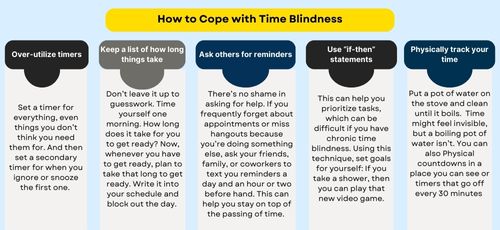
Coping skills for time blindness can include:
- Over-utilize timers: Set a timer for everything, even things you don’t think you need them for. And then set a secondary timer for when you ignore or snooze the first one.
- Keep a list of how long things take: Don’t leave it up to guesswork. Time yourself one morning. How long does it take for you to get ready? Now, whenever you have to get ready, plan to take that long to get ready. Write it into your schedule and block out the day.
- Ask others for reminders: There’s no shame in asking for help. If you frequently forget about appointments or miss hangouts because you’re doing something else, ask your friends, family, or coworkers to text you reminders a day and an hour or two before hand. This can help you stay on top of the passing of time.
- Use “if-then” statements: This can help you prioritize tasks, which can be difficult if you have chronic time blindness. Using this technique, set goals for yourself: If you take a shower, then you can play that new video game.
- Physically track your time: You may have heard of the boiling water technique. Time might feel invisible, but a boiling pot of water isn’t. For example, you clean until the pot of water boils, and then you have to start making dinner. Physical countdowns in a place you can see or timers that go off every 30 minutes are all good ways to physically measure time.
These are just a few of the coping mechanisms you can use for time blindness. If you need more support, a therapist would be happy to meet with you. Licensed therapists can help with time blindness and related mental health issues, including ADHD.
Contact Lifebulb to schedule a session with a therapist today.
.webp)
.webp)

-(1).webp)