.webp)
Active listening is an important communication skill. It goes beyond just hearing the words someone is saying. True active listening is comprehending both the meaning and the intent behind someone’s words.
When you actively listen, you’re removing yourself from the center of the conversation. This allows it to flow between two people.
True conversation involves 2 people. When you talk with the intent of being understood, you’re delivering a message. When you talk with the intent of understanding, you’re having a conversation.
What Is Active Listening?
Active listening is a big part of healthy communication. When you actively listen, you’re letting your communication partner know that you care about what they say. The recipient feels valued and heard.
You’ll also understand the conversation better. Nonverbal communication is very important in understanding someone’s true meaning.
When you’re not actively listening, you miss out on important cues like tone of voice, facial expressions, and body language. This can lead to the central message being misunderstood.
Active listening can be harder than it looks, though. We naturally want to be understood, and that means many of us spend the time we’re supposed to be listening preparing a response.
Active Listening Skills
Active listening is easier said than done. Sometimes we can get so caught up in trying to actively listen that we forget to actively listen!
Here are some skills you can practice to be a better active listener. Start by implementing just one or two of them and build up from there.
- Maintain Eye Contact: Eye contact is a good way to let your conversation partner know that you are engaged and listening.
- Put Away Distractions: “Phubbing” describes the behavior of using your phone while you’re talking to someone. It deteriorates the conversation and the relationship. Put down your phone and other distractions.
- Focus on What They’re Saying: It’s easy to get caught up in planning what you’re going to say to respond. These thoughts might come and go, but try to stay focused on what they’re saying. You can collect your thoughts and respond once you fully understand what they’re saying.
- Show Engagement: Nod your head and offer small vocal sounds of engagement. Things like, “Mm-hmm”, or “Oh, wow!” and other small expressions show engagement without derailing the conversation.
- Reflect back what you’re hearing: When there’s a time for you to speak, start by reflecting back what you heard. “It sounds like you’re feeling really alone right now after your roommate moved out.”
- Ask Clarifying Questions: If there was anything that confused or interested you, ask about it!
- Focus on your body language: Lean forward to show interest and try uncrossing your arms to show openness. These are small nonverbal body language signals that can communicate openness and willingness to listen.
- Validate their feelings: The time for your own opinion will come, but first, validate what you heard.
- Avoid judgment: You might disagree with what they’re saying, and if you’re trying to reach some sort of solution, then you’ll need to voice that disagreement. But while you’re listening, try to avoid judgment. Fully understand what they’re saying and why they’re saying it, and then formulate a response.
- Approach with curiosity: Unless you’re in an active debate (which most conversations are not), hold back your assumptions and quick conclusions. Instead, be curious about what they’re saying. Tamp down on knee-jerk, emotional reactions until you’re sure you understand what they’re saying.
- Allow silences to linger: Most people are quick to fill in silence, but silence can be a good part of a conversation. Instead of jumping in to fill every silence, allow them to sit for a little. See if they have anything else to say. Once you know they’re done talking, you can begin.
- Don’t give advice unless they ask for it: It’s natural to want to fix someone’s problems, but first ask yourself if that’s really what they want. Many people just want to vent or explain their emotions. There are some situations that naturally warrant giving advice. If you are someone’s mentor or boss, or if you have personal experience that you want to inform them of. Giving advice is not necessarily a bad thing, but do so only after you’ve fully understood what they’re saying and you have explicit or implicit permission to do so.
Using a combination of these techniques will lead to deeper conversations and greater understanding.
What are the 3 R’s of Active Listening
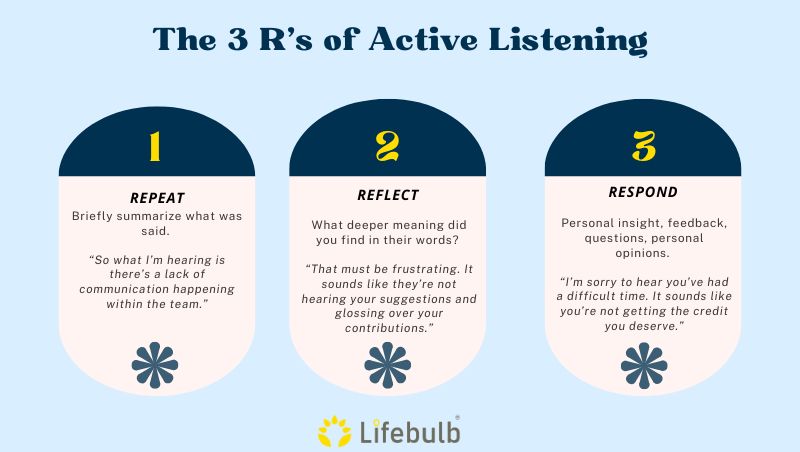
If you have trouble remembering all the skills we listed above, the 3 R’s of active listening can help.
Use these 3 R’s when you’re having trouble remembering what active listening involves.
- Repeat: Briefly summarize what was said.
- “So what I’m hearing is there’s a lack of communication happening within the team.”
- Reflect: What deeper meaning did you find in their words? This can include noticing their emotional state or focusing on specific parts of what they said.
- “That must be frustrating. It sounds like they’re not hearing your suggestions and glossing over your contributions.”
- Respond: Now it’s your turn to add to the conversation. What personal insight or feedback do you have? If you have any clarifying questions, now is the time to ask. Now could be the time to state agreement/disagreement, but make sure you fully understand what they're saying first.
- “I’m sorry to hear you’ve had a difficult time. It sounds like you’re not getting the credit you deserve.”
These 3 Rs of active listening can make your communication partner feel heard and understood.
Remember that the goal of active listening isn’t to check these three boxes; it’s to listen! Don’t get so held up with trying to formulate a perfect reflection that you forget to actually listen. These 3 Rs will come naturally if you start implementing the active listening techniques above.
Therapy for Better Communication
Communicating is hard! It’s okay if it doesn’t come naturally to you. Therapy isn’t just for healing from mental health issues. A therapist can help you learn the skills you need to become an excellent communicator.
Contact Lifebulb to be scheduled with a therapist today.


.webp)