
Strong work ethic. Attention to detail. Go-getter.
Are those positive or negative attributes? Most people would agree that they are positive, even desirable, personality traits. But anything in excess can be dangerous. This is true for many seemingly healthy things: sunlight, exercise, and vitamin supplements are all great ways to improve mental health and overall well-being, but take too much of any one and you’re in a dangerous situation. The same is true for personality traits.
When you take positive traits like a strong work ethic or attention to detail and push them to their max, you might find yourself with perfectionism.
Perfectionism is a personality trait characterized by high personal standards and overly critical self-evaluations. Perfectionists accept the best, or nothing at all.
While this trait can propel people to great heights, it comes with many drawbacks to their mental, physical, and relational health, and can even undermine the very feats perfectionists set out to accomplish.
Traits of a Perfectionist
Do you think you might be a perfectionist? Perfectionists are often scared to work on themselves because they fear losing the drive that has helped them get to where they are. Rest assured that there are ways to achieve success and stay physically and mentally healthy. The first step is to acknowledge perfectionist traits, which can include:
- Unrealistically high standards: Where others are okay with just an A, you have to get 100%, all the time. Others may look at your successes and see just that—success! But you look at them and think of all the work that is still left to be done.
- Fear of failure: You’re not always driven by the need to succeed, in fact, it might feel like you’re more driven by the desire not to fail. When you succeed, you just feel relief. When you fail, it feels like the end of the world.
- Constant self-criticism: You’re not able to internalize your accomplishments, instead always finding things that are wrong about what you do. There might be a constant inner critic that hates you and everything you do.
- Procrastination: Because you deeply fear failure, you may find yourself procrastinating more. The thought process behind this might be that you can’t fail if you never try. However, this often delays the inevitable and leads to a last-minute struggle to get everything done perfectly.
- All-or-nothing thinking: The thought of “If it's not perfect, it's a failure” is a dominant one in your life. This is a common cognitive distortion. You might feel like if it’s not perfect, it’s not worth doing, and if you fail in any tiny way, then you fail at the whole. For example, if you have a morning routine and you do all of it except you forgot to brush your teeth, you might see the whole morning as a failure.
- Difficulty delegating tasks: Delegating tasks is the ability to assign parts of a task to other people, to make the task as a whole go quicker and more smoothly. If you have perfectionist qualities, you’ll have trouble handing over that control to others. You might also micro-manage members of your team.
- Overemphasis on results: It doesn’t matter how you get to the end result; you just have to get there. Life is definitely about the destination, not the journey. This thought process can lead to overexertion and burnout.
- Constant comparison: It doesn’t matter how high you climb, you’ll always be comparing yourself to others, usually in a way that is not favorable to yourself.
- Sensitivity to criticism: You often take feedback personally and have trouble hearing negative feedback, because it is perceived as a failure. Even if the feedback will lead to a more perfect result, it’s hard to hear it at the moment.
- Burnout or exhaustion: Burnout is common amongst perfectionists as they try to meet those too-high self-imposed standards.
- Delaying or avoiding new challenges: Perfectionists will often delay new challenges unless there is a guaranteed success. For example, they may not pick up a new hobby because they know they’ll be bad at it.
- Equating self-worth with achievements: Perfectionists often have low self-esteem and self-worth because the basis for their self-worth is their accomplishments. But their accomplishments have an eligibility timer on them. The win they had a few years ago doesn’t matter anymore. It’s only what they’re doing now, at this moment, that counts toward their self-worth.
Perfectionism is common and, with therapy, can be distilled down in a healthy personality trait that is beneficial instead of harmful.
What Causes Perfectionism
Perfectionism is tied to many mental health disorders, including anxiety, depression, OCD, ADHD, and more. Some causes of perfectionistic traits in adulthood include:
- High parental expectations or criticism during childhood
- Conditional love or approval based on achievements
- Growing up in a highly competitive environment
- Fear of failure or punishment
- Low self-esteem or feelings of inadequacy
- Desire for control in unpredictable or chaotic environments
- Cultural or societal pressure to succeed or "have it all"
- Trauma or adverse childhood experiences that lead to hypervigilance or overcompensation
Perfectionism is also linked to mental health disorders. Although perfectionistic traits do not mean you have OCD or ADHD, there is a strong overlap.
Curious if you have OCD or ADHD? Take our free, online OCD test or our free, online ADHD test.
Perfectionism OCD
Perfectionism OCD is a subtype of OCD. In this type, compulsions and obsessions are focused on things being “just right”, or perfect. Many people think of obsessively aligning pictures on the wall or making sure everything has its place when they think of OCD, and while this is an example of perfectionism OCD, it’s far from the only one.
If you have significant distress when things aren’t perfect, and you spend much of your time trying to get things perfect, then you might have perfectionism OCD.
It’s important to remember that not everyone who is a perfectionist has OCD. OCD is a mental illness characterized by obsessive thoughts and behavioral compulsions. It leads to significant distress and impairment in daily functioning.
What’s the difference between OCD and perfectionism? Rereading all of your work corresponds—from emails to informal message chats— for typos, tone, and factual information is most likely perfectionism. Rereading all your work communications so that sentence lengths match up, word count is the same, or some other irrational but important-to-you factor is most likely OCD.
ADHD and Perfectionism
There is less of an overlap between ADHD and perfectionism than that of OCD and perfectionism, but still a notable link between the two.
ADHD and perfectionism stems from a few ADHD traits:
- Not knowing when to stop working on a project. (An executive function skill that may be missing in many people with ADHD.)
- Making up for previous mistakes or not feeling good enough.
- Incorrectly guessing the time demands of a project. For example, “just one more thing” could take hours, but it’s hard for people with ADHD to understand that with their time blindness.
If you struggle with ADHD and perfectionism, talk with a therapist about how counseling can help you today.
How to Stop Being a Perfectionist
You’ve read through this list and each point hits home. You’re pretty sure you’re a Perfectionist, but now what?
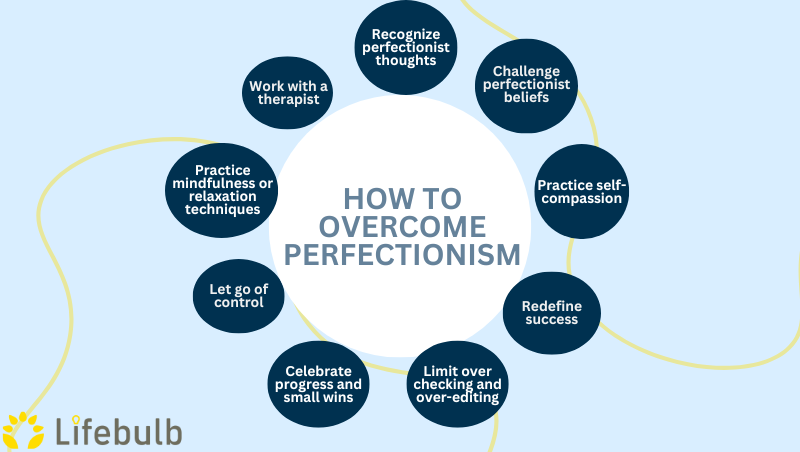
The good news is that you are not doomed to a life of unreachable high standards. It is possible to overcome perfectionism. Here are some steps:
- Recognize perfectionist thoughts: Start by becoming aware of unrealistic standards or all-or-nothing thinking. It can be helpful to track when you notice these thoughts and what the triggers were.
- Challenge perfectionist beliefs: Ask yourself: “Is this standard reasonable?” or “What’s the worst that could happen?”. Then, try to put down the task, even if it feels imperfect. Start with something small, like just leaving off the finishing touches.
- Practice self-compassion: Treat yourself with the same kindness and understanding you'd offer a friend. Understand that perfectionism can take its toll on your mental health and trying to break perfectionistic habits can be exhausting. What can you do to be kind to yourself today?
- Redefine success: Focus on growth, learning, and effort rather than flawless results. Make goals around how you will improve instead of how perfect something can be.
- Limit over-checking and over-editing: Set time limits or a maximum number of revisions for tasks. Force yourself to walk away after a certain time. It can help to find an accountability buddy to hold you to this.
- Celebrate progress and small wins: Acknowledge what you’ve accomplished—even if it’s not “perfect.” Celebrate these successes with friends and family.
- Let go of control: Practice delegating or accepting help to build trust in others. Can’t delegate to just anyone? That’s okay. Pick a handful of people that you can trust, and then trust them with their task completely. Don’t micromanage.
- Practice mindfulness or relaxation techniques: Tools like meditation can help calm anxious, perfectionist thinking. If you’re trying to break perfectionistic behaviors by setting editing limits or handing in work you don’t think is “perfect”, mindfulness can help you ride out those stressful moments.
- Work with a therapist: Cognitive Behavioral Therapy (CBT) and other therapeutic approaches can address perfectionism at its core. If you struggle with perfectionism and it is majorly impacting your life, talking to a therapist can help.
Are you ready to stop living your life shackled to the whims of perfectionist standards? Lifebulb has affordable, online therapy with sessions available today. Give our team a call or browse our list of therapists near you.
.webp)
.webp)
.webp)
.webp)